
432 Hz vs 440 vs 444: The Math Verdict on 13 Tunings
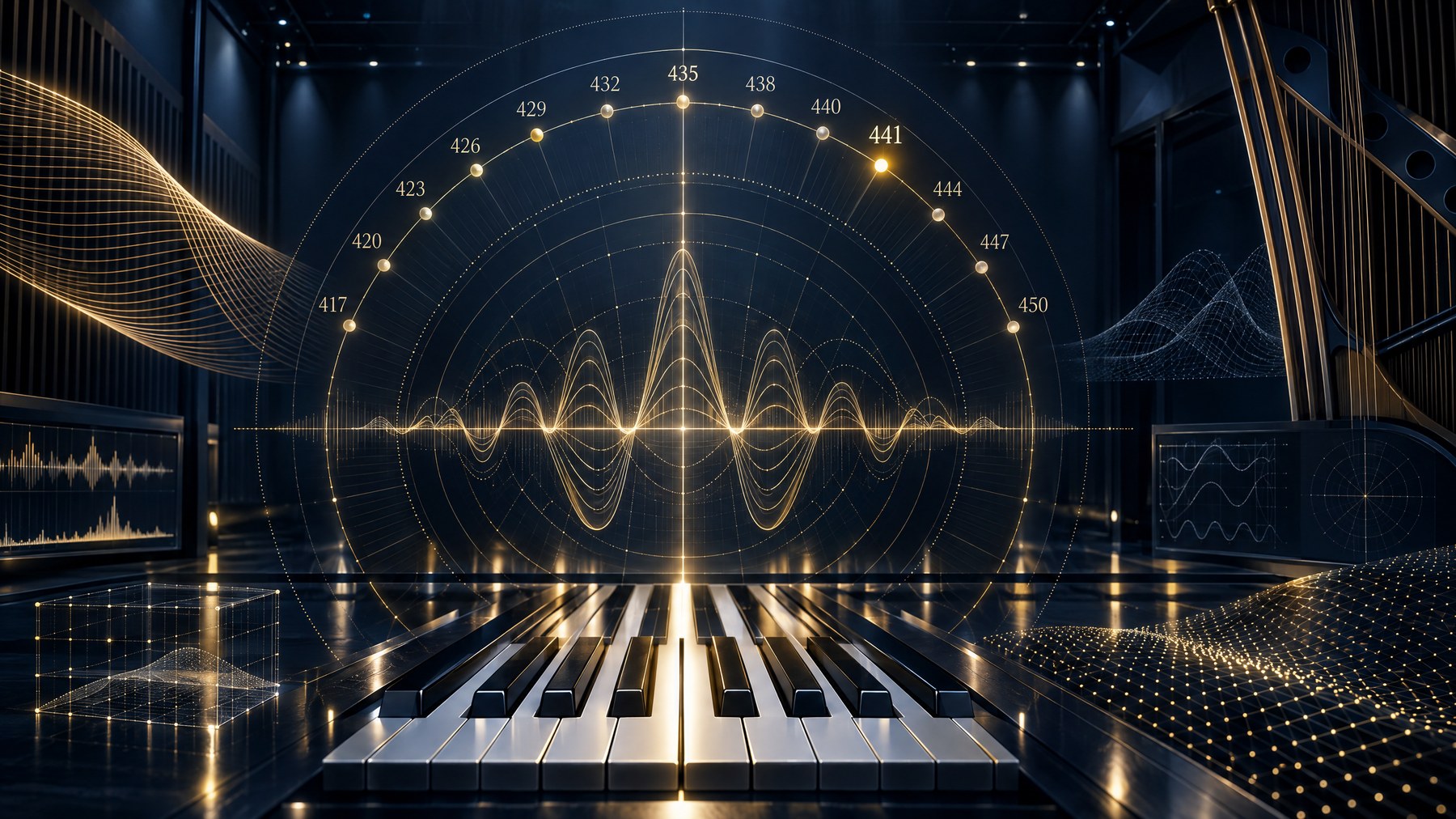
The 432 Hz debate has been asking for one “best” number. The math produces a more interesting answer. Across 13 A4 references from 417 to 450 Hz, the supplied audit scores an explicit all-octave model rather than a mystical story. Under that declared composite, 441 Hz ranks first, followed by 450 Hz and 432 Hz. 440 Hz remains the interoperability reference. 444 Hz has a different profile again. The point is not to replace one absolute claim with another. It is to make the design question specific enough to answer.
The result is useful because a reference pitch is only one coordinate in a larger musical or signal-design system. An A4 number can determine the scale’s absolute placement. It does not, by itself, determine interval structure, waveform, amplitude contour, phase relationship, duration, routing, loudness, a field at tissue, or a human outcome. Once those categories are separated, the 432, 440, and 444 conversation becomes much clearer.
The short answer: 441 Hz wins the disclosed all-octave composite
The free mathematical audit supplied for this feature evaluates 13 candidate A4 references from A0 through A9 using six declared components: a sensory-dissonance model, Pythagorean integer-Hz structure, octave integrality, exact 44.1 kHz digital periodicity, an explicitly labeled Schumann-distance arithmetic term, and a relative stiff-string term. The formulas, candidates, and weights are disclosed in the report. We independently reproduced the composite calculation to rounding precision.

| Rank | A4 reference | Reproduced composite | What it means |
|---|---|---|---|
| 1 | 441 Hz | 76.0 | Leads under the disclosed all-octave balance of arithmetic, digital periodicity, string-model, and compatibility terms. |
| 2 | 450 Hz | 75.5 | Leads the supplied same-string inharmonicity term among the tested candidates. |
| 3 | 432 Hz | 74.7 | Leads the Pythagorean-integer and number-smoothness portion of the model. |
| 4 | 420 Hz | 70.3 | Strong digital-periodicity and integer structure under the stated rules. |
| 5 | 440 Hz | 66.8 | The ISO reference and direct interoperability leader, even though it is fifth in this particular composite. |
| 6 | 444 Hz | 66.4 | Close to 440 in the all-octave composite, but not a leading reference under the disclosed aggregate. |
| 7 | 438 Hz | 65.8 | Near-standard alternative with a middle composite score. |
| 8 | 423 Hz | 62.1 | Lower composite under the declared balance. |
| 9 | 435 Hz | 62.0 | Lower composite under the declared balance. |
| 10 | 447 Hz | 61.8 | Lower composite under the declared balance. |
| 11 | 426 Hz | 61.1 | Lower composite under the declared balance. |
| 12 | 429 Hz | 59.7 | Lower composite under the declared balance. |
| 13 | 417 Hz | 58.2 | Lowest composite among the 13 tested candidates. |
The ranking is transparent, not absolute. Change the objective function and the leader can change. The useful conclusion is not “441 heals better.” The useful conclusion is that 441 is the numerical leader when these particular criteria and weights are made explicit. That is much more informative than treating a single reference number as a complete signal description.
Why the winner changes when the question changes
There are at least five different questions hidden inside the phrase “Which tuning is more harmonic?” The audit makes those questions visible. If the goal is a disclosed all-octave composite, 441 Hz is first. If the goal is an integer-Hz Pythagorean lattice, 432 Hz is first. If the goal is the supplied same-string inharmonicity model, 450 Hz is first. If the goal is day-to-day ensemble compatibility, 440 Hz is first because it is the ISO standard. If the question is interval ratios or ideal oscillator coherence, every reference ties because a uniform rescaling preserves ratios.

This is also where popular claims about “better harmonics” need a precise translation. If a scale is moved from A4 = 440 Hz to A4 = 432 Hz, all of its frequencies are multiplied by the same constant. A perfect octave remains 2:1. A perfect fifth remains 3:2. The harmonic series of an ideal oscillator remains integer multiples of its fundamental. Interval ratios are scale-invariant. In this narrow but foundational sense, 432, 440, 441, 444, and 450 do not have different ideal harmonic-series quality just because their A4 reference differs.
Coherence is a second category error when it is assigned to the pitch label alone. Oscillator coherence concerns stability, phase noise, jitter, bandwidth, and the actual output chain. A label such as “432 Hz” identifies a target frequency. It does not certify the temporal stability or phase behavior of the device reproducing it. That distinction is basic signal engineering, and it makes a single-number marketing claim incomplete by design.
What gives 441 Hz its composite lead
In the supplied model, 441 is a particularly efficient compromise. It is 32 × 72, which gives it a smooth integer factorization under the report’s arithmetic rule. At a 44.1 kHz sample rate, 44,100 ÷ 441 equals exactly 100 samples per A4 cycle, which gives 441 a clean digital-periodicity result at that sample rate. It is also only one hertz from the ISO reference, so it remains close to standard ensemble pitch. Those properties combine cleanly under the audit’s weights.
That does not transform 441 into a universal music standard or a health claim. It means only that, for a defined computational exercise that values all-octave behavior, integer properties, a 44.1 kHz implementation, a stiff-string proxy, and proximity to 440, 441 is a strong candidate. It is a practical example of how declared constraints, not slogans, generate a technical conclusion.
Why 432 Hz remains mathematically distinctive
432 has real number-theoretic appeal. It factors as 24 × 33, and its powers of two make it unusually generous across octave division. Under the audit’s Pythagorean integer-Hz test, 432 leads because multiple scale relationships yield clean integer values across the modeled register. That is a genuine property of the number when hertz are used as the unit.
It is important to state what that property means and what it does not. It is an arithmetic property of a unit-dependent calculation. It does not establish that a listener’s nervous system, DNA, water, or a medical condition responds preferentially to 432. The historical case for alternative pitch is also richer than social-media folklore: pitch practice varied substantially across locations and eras before broad standardization, with historically documented examples near 435, 438, 444, and 450 Hz.[3] A440 became a useful coordination standard, not a proof that other tuning references cannot be used.
Why 450 Hz wins the supplied string model
Real strings are not ideal strings. Bending stiffness makes upper partials depart from exact integer multiples of a fundamental, an effect known as inharmonicity. The magnitude depends on properties such as string length, radius, tension, and boundary conditions. For a controlled same-string comparison, the supplied audit uses a relative term in which the higher candidate reference lowers that stiffness proxy. Under that stated condition, 450 Hz leads the tested list.[4]
The qualifier matters. A piano, guitar, violin, synthesizer, handpan, and software oscillator are not interchangeable systems. The supplied string result is a narrow acoustic-model result, not a declaration that 450 is universally more musical, more comfortable, or more effective. It is still useful because it demonstrates something often missed in tuning debates: a physical instrument has material constraints that do not appear in a pure sine-wave argument.
Why 440 Hz remains the interoperability reference
ISO 16 specifies 440 Hz for the A in the treble stave and was confirmed as current in 2022.[1] NIST likewise identifies A440 as an internationally recognized musical-pitch standard while noting that pitch discrimination depends on listener and context.[2] That makes 440 the clearest reference for a musician joining a conventional ensemble, matching a commercial recording, or collaborating with instruments calibrated to the standard. It is the shortest path to interoperability.
Interoperability is a legitimate design criterion. It simply answers a different question from integer factorization or a modeled stiff-string comparison. In the audit’s all-octave composite, 440 ranks fifth because the composite weights other attributes too. In working musical life, however, A440’s coordination value is often decisive. A disciplined comparison can hold both statements at once.
What 444 Hz does and does not win
444 Hz is close enough to 440 Hz to remain familiar as an alternative concert-pitch choice, and the same-string model gives higher references a modest relative advantage over lower references. But under the audit’s disclosed all-octave composite, 444 ranks sixth, not first. It does not lead the Pythagorean integer metric, digital-periodicity term, compatibility criterion, or total composite.
This is a valuable corrective because it keeps the article out of binary marketing. 444 Hz is not “bad,” and 432 Hz is not “wrong.” The technical question is whether a designer tells the reader which property is being optimized. A well-built program should explain its architecture rather than imply that one number settles the entire question.
The Schumann calculation: an arithmetic comparison, not a biological mechanism
The audit includes distance to the nearest integer multiple of 7.83 Hz because that claim appears frequently in alternative-tuning conversations. The arithmetic can be calculated, but it does not create a biological inference. The Earth-ionosphere Schumann fundamental is an electromagnetic resonance in the approximate 7.8 Hz region, not an audio tuning reference. Measurements also vary with time and conditions. One week-long measurement series reported the fundamental varying roughly from 7.5 to 8.1 Hz.[5]
For that reason, the article reports the Schumann component as a declared arithmetic term in the supplied audit, not as evidence of a human “alignment,” a therapeutic action, or a reason to treat a tone as a field. Mathematics can show closeness to a chosen multiple. It cannot supply a mechanism that has not been demonstrated.
What the direct 432 versus 440 listening studies actually add
Human research on pitch-reference comparisons is narrower than online claims suggest. The directly relevant studies we located compare 432 Hz with 440 Hz. They do not test 441, 444, 450, or the full 13-reference set. A small double-blind crossover study of 33 healthy participants reported a modest mean heart-rate difference between conditions while other measures did not reach significance.[6] A small randomized dental-procedure study and a later single-center emergency-worker pilot each examined short listening contexts with their own outcomes and limitations.[7] [8]
A recent double-blind crossover warm-up study in kickboxers reported different results again, with its 440-Hz preferred-music condition performing better for the study’s specific performance and mood outcomes.[9] The intellectually honest conclusion is not that one reference pitch has won human biology. It is that small, context-specific comparisons have produced mixed outcomes, while the full 13-reference mathematical ranking remains a separate exercise.
From a pitch label to a complete BioPhi-style listening design
A static pitch reference is a useful starting coordinate, but it is not a complete program specification. A composed session can define interval relationships, component summing, amplitude envelopes, timed phase transitions, stereo routing where specified, and an optional haptic or compatible-coil output path. That is the design space in which a program becomes more than a stationary tone.

This is the constructive lesson for the end of static-frequency thinking. A repeated mono tone can be valid for a defined listening purpose. It is not the only architecture available. A transparent BioPhi-style design can organize changing spectral material, phase roles, envelopes, routing, and intentional transitions, with the user able to choose audio-only use or compatible optional output layers. Sensory adaptation literature supports the ordinary observation that repeated sound processing changes over time. It does not prove that a changing consumer program prevents cellular adaptation or delivers superior medical results.
Where a program specifies separate left and right audio channels, it can also specify a binaural component. Binaural beats are a distinct perceptual construct created by slightly different tones delivered separately to the ears, not a property of every mono tone. The research literature on binaural-beat outcomes is heterogeneous, so this article treats stereo routing as a documented design variable, not an established entrainment effect.[10]
Seven-day listening exploration
This is a listening and design-exploration routine, not a treatment schedule or a frequency dose. The daily primary is 432Hz Full Spectrum Golden Ratio Harmonic Sweep Energetics. Start with it each day. Run every linked session for its complete native duration as displayed in the app. Keep a 10-minute quiet gap between sessions. The quiet interval makes the comparison intentional rather than turning a day into one uninterrupted stack. After Day 7, take one full week away before considering an optional repeat.
After Day 7: take one full week away. If you return to the routine, keep the same low-intensity, observation-first approach. Notice practical experience variables such as comfort, concentration, volume, speaker or headphone setup, and whether the session fits your evening or workday. Do not use subjective impressions to diagnose a condition or change medical treatment.
Optional listening and compatible-device setup
Audio alone is sufficient for the tuning comparison. If you use optional hardware, treat each layer as a separate, comfort-centered output path rather than as a way to recreate a clinical exposure or multiply a promised result. A program with a stereo binaural specification requires separate left and right audio delivery to preserve that design condition. A haptic vest is an optional vibrotactile listening layer. A compatible coil has an actual output that depends on its device, cable, amplifier, geometry, gain, placement, and distance. None of those hardware choices turns this article into medical advice.
| Layer | Resource | Responsible role |
|---|---|---|
| Platform | Frequency Healing App | Run the linked primary program first, with volume set for comfortable listening. |
| Compatible coil | iTorus i2 or iTorus i5 | Optional compatible output path. Follow manufacturer instructions and do not attempt to infer field dose from an audio file. |
| Haptic | Woojer Vest 4 using code EPEMF10 | Optional low-level sensory layer, used for comfort and listening context rather than a therapeutic claim. |
| Imprinting | Metatronic Flower of Life Dual Frequency Imprinter | Optional personal ritual layer only. It is not a medical device, nutrition substitute, or treatment. |
Sound, safety, and study boundaries
Keep volume at a comfortable level and stop if sound produces discomfort, dizziness, agitation, headache, or distress. Do not drive, use machinery, or place yourself in a situation requiring sustained external attention during an immersive listening session. If you use a coil or magnetic component, do not use it around implanted electronic medical devices unless your treating clinician and the device manufacturer have specifically cleared the exact setup. Magnetic sources can interfere with some implanted cardiac devices.[11]
Frequency references are not diagnosis or treatment. They do not replace hearing care, mental-health support, medication, emergency care, or clinician guidance. The mathematical result in this feature is a reproducible score within a declared model. The human studies are small, context-specific comparisons of 432 and 440 only. That evidence cannot rank 441, 444, or 450 for health outcomes.
Educational and wellness disclaimer: This article is for education and general wellness information only. It does not provide medical advice, diagnosis, or treatment. It does not establish that a program, frequency, app, or device will produce a specific physical, psychological, or clinical result. Consult a qualified professional for health questions and follow the manufacturer’s instructions for any device.
The design conclusion
The strongest result is not a new frequency mythology. It is a better way to ask the question. 441 Hz wins the supplied all-octave composite. 432 Hz wins the Pythagorean-integer criterion. 450 Hz wins the supplied same-string inharmonicity criterion. 440 Hz wins interoperability. The reader can inspect the definitions, decide which objective matters, and distinguish a mathematical property from a human-outcome claim.
For program design, this is where one-number thinking gives way to a more complete composition. A reference pitch can be chosen deliberately, then embedded in a sequence with specified timing, envelopes, harmonics, routing, phase relationships, and optional output paths. That is not a claim of medical superiority. It is a more technically complete vocabulary for building and evaluating a session.
Free download: the complete mathematical audit
Want the equations, 13-reference tables, all-octave component scores, and alternative weighting views? Download the complete report here:
Download the free 432 vs 440 vs 444 Mathematical Audit PDF
Related Articles
- Calminity vs PEMF Healing: Static Frequency vs BioPhi Programs
- Can 4 Hz Binaural Deepen Meditation? UltraMind OBE Threshold Explored
- Heart-Brain Love Matrix: 5-Phase Neurocardiac, Autonomic & Compassion BioPhi-Harmonic Energetics
References
- International Organization for Standardization. ISO 16:1975 Acoustics: Standard tuning frequency (Standard musical pitch). ISO. Direct source.
- National Institute of Standards and Technology. Time and Frequency from A to Z: Musical Pitch. Direct source.
- Provenzano C. Perfect Pitch: 432 Hz Music and the Promise of Frequency. Journal of Popular Music Studies. 2021. Direct source.
- Russell DA. Inharmonicity due to Stiffness for Guitar Strings. Penn State Acoustics and Vibration Animations. Direct source.
- Votis C, et al. Design and implementation of a low-cost, portable Schumann resonances measurement system. EURASIP Journal on Wireless Communications and Networking. 2018. Direct source.
- Calamassi D, Pomponi GP. Music tuned to 440 Hz versus 432 Hz and the health effects: A double-blind cross-over pilot study. Explore. 2019. Direct source.
- Aravena PC, Almonacid C, Mancilla MI. Effect of music at 432 Hz and 440 Hz on dental anxiety and salivary cortisol levels in patients undergoing tooth extraction: A randomized clinical trial. Journal of Applied Oral Science. 2020. Direct source.
- Calamassi D, et al. Listening to music tuned to 440 Hz versus 432 Hz to reduce anxiety and stress in emergency nurses during the Covid-19 pandemic: A double-blind, randomized controlled pilot study. Acta Biomed. 2022. Direct source.
- Jebabli N, et al. Effects of listening to 432 Hz and 440 Hz music during warm-up on mood state, physical and physiological performances in kickboxers: a randomized, double-blind, crossover study. PeerJ. 2025. Direct source.
- Ingendoh M, Posny ES, Heine A. Binaural beats to entrain the brain? A systematic review of the effects of binaural beat stimulation on brain oscillatory activity, and the implications for psychological research and intervention. PLOS ONE. 2023. Direct source.
- U.S. Food and Drug Administration. Magnets in Cell Phones and Smart Watches May Affect Pacemakers and Other Implanted Medical Devices. Direct source.
Explore PEMFHealing.app
Your companion for structured frequency programs and progress tracking.
Why full spectrum frequencies can feel stronger than a single tone
- Broader coverage across biological windows, not a narrow peak.
- Harmonics and sidebands can support entrainment and coherence.
- People vary by tissue state and time of day, so spectrum raises the chance of a match.
- Lower adaptation risk compared to repeating a single tone for long periods.
Dual channel vs single channel
- Two independent channels can run complementary programs at once.
- Phase and field options may create a smoother perceived field.
- Target local and systemic aims together, for example focus plus relaxation.
Why we use multi modality, not only Rife
Complex systems benefit from more than one input. We layer modalities to address different pathways and timescales.
- WBV for circulation and lymph support
- VibroAcoustics for relaxation and coherence
- Pro Rife and Ultra Rife targeted frequency sets
- ElectroHerbalism mild field patterns with botanicals
- NeuroCeptors gentle neuromodulation for calm and focus
- Biophotonics light based cellular signaling support
- Scalar field coupling for subtle energy work
- Plus PEMF, photobiomodulation, breathwork, HRV awareness, and more
Our ecosystem
-
Imprinter imprint supportive signatures into water, supplements, crystals, or pendants.
Metatronic Flower of Life Dual Frequency Imprinter -
iTorus i2 portable PEMF coil for on the go sessions.
iTorus i2 -
iTorus i5 higher output portable PEMF.
iTorus i5
Disclosure: Some links may be affiliate. If you purchase, we may receive a small commission at no extra cost to you.
Disclaimer: This content is for informational purposes only and is not medical advice. Always consult a qualified healthcare professional before starting any new therapy or using frequency based devices.
Related articles
- Calminity vs PEMF Healing: Static Frequency vs BioPhi Programs
- Vascular Flow & Endothelial Support: Research and 8-Phase Guide
- Art Tawanghar’s 2015 AI Wellness Loop: Soaak, WHOOP & Endel
- Calmity vs PEMF Healing Platform: Scope, Evidence, and the Free Report
- Spinal Fusion Bone Stimulators: FDA Status, Evidence & Safety
- Parkinson’s NeuroMotor Matrix: 7-Phase Bioelectric, Binaural, Cranial-Nerve & Motor-Circuit BioPhi Energetics