
Cochlear Frequency Mapping: 5-Phase BioPhi Listening Guide
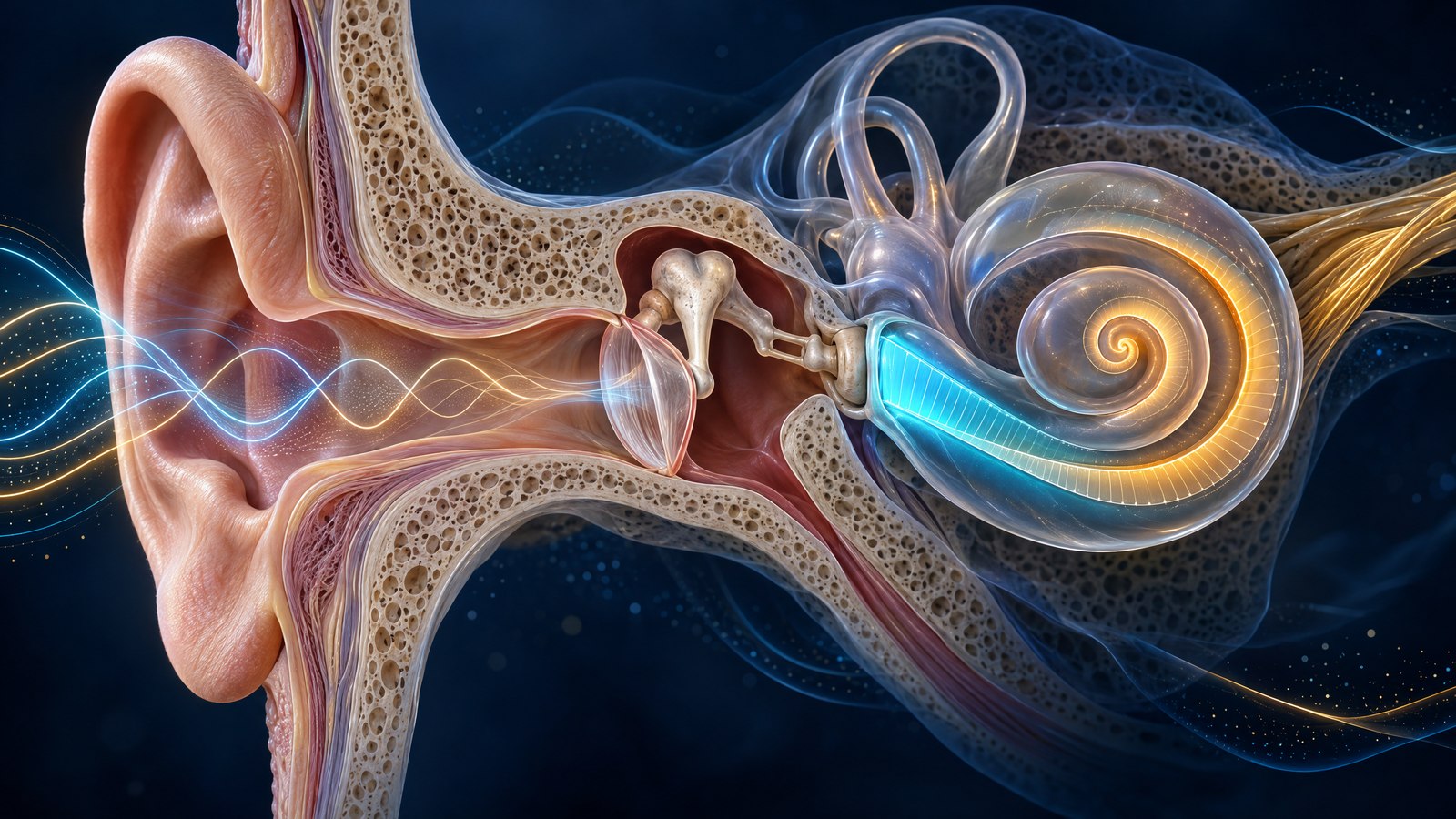
Your ear does not receive sound as one undifferentiated signal. It separates frequency along a remarkably organised living structure. Within the spiral of the cochlea, higher-frequency components preferentially excite regions closer to the base, while lower-frequency components travel towards more apical regions. Hearing begins with this physical organisation, then develops through sensory transduction, nerve timing and further auditory processing.[1] [2]
The quick answer: cochlear frequency mapping is the organisation of frequency-related information by place and timing. In clinical implant work, frequency allocation also means assigning incoming sound bands to a device’s stimulation channels. This feature explores how that research can inspire a five-phase listening composition, with moving pitch, recurring patterns and changing sound colour. The creative opportunity is to experience an organised sound journey, not to reprogram an implant or repair hearing through a playlist.[3] [7]
The featured programme is Cochlear Frequency Mapping BioPhi Matrix 5-Phase Auditory Tonotopy & Frequency Allocation Research Energetics in the PEMF Healing App. Its five-phase format is creator-described listening design. The hearing studies discussed below supply its research context; they did not test this programme. The guide includes the supplied full spectrogram, exact companion links and a seven-day practice for comfortable, attentive listening.

The pitch map inside the cochlea
Sound entering the ear sets the eardrum and middle-ear structures in motion. That motion drives pressure changes in the cochlear fluids and a travelling wave along the basilar membrane. Because the cochlear partition’s mechanical properties vary along its length, different frequency components produce different response patterns. This arrangement is called tonotopy.[1] [2]
The broad rule is base for higher frequencies, apex for lower frequencies. It is a graded organisation, not a set of sealed boxes. Nearby response regions overlap. A complex musical sound therefore produces an organised pattern across the cochlea rather than activating a single isolated “frequency point.” That is one reason a frequency number alone tells us so little about a complete listening experience.[2] [3]
Inner and outer hair cells make different contributions. Inner hair cells provide the principal sensory output to the auditory nerve. Outer hair cells provide active mechanical feedback that helps increase sensitivity and sharpen tuning. The cochlea is not just a passive filter: its mechanical and cellular functions interact.[2]
There is also a timing code. Auditory-nerve discharge patterns can preserve aspects of waveform periodicity, complementing the place pattern. A useful explanation of pitch therefore needs both where activity occurs and how activity is timed, followed by processing beyond the cochlea. Place is not the whole story, and neural timing is not a promise that an external tone will impose a particular brain state.[3] [4]

Why pitch, timbre and motion deserve separate attention
Pitch is the perceived highness or lowness of a sound. Timbre is the sound quality that helps distinguish sources with a similar pitch and loudness, such as a sustained tone and a plucked instrument. Spectral structure and changes over time both matter. Harmonics, attacks, decays and the balance of partials can change the character of a sound without simply making it louder.[4]
This gives a composer several distinct dimensions to organise. Pitch can move. Harmonic content can change. A second voice can create contrast with the first. Stereo presentation can alter the spatial impression. In the featured programme’s creator-described design, those dimensions are arranged as a journey rather than offered as an isolated tone. Its useful differentiation is the authored relationship between sounds over time, not the suggestion that more frequencies automatically produce more benefit.
For a listener, this turns a vague instruction to “feel the frequency” into something concrete: notice whether a sound becomes brighter, whether a familiar contour returns, whether layers seem to converge, or whether a passage invites quieter attention. You are observing a listening experience, not diagnosing your cochlea. The scientific vocabulary makes the experience more intelligible without requiring a medical interpretation.
What frequency allocation means in a cochlear implant
A cochlear implant processor analyses incoming acoustic information and its implanted system delivers electrical stimulation through contacts inside the cochlea. A frequency-allocation table assigns acoustic frequency regions to the processor’s channels and corresponding stimulation. The allocation is distinct from the physical position of an electrode, its electrical pulse rate, its current settings and the recipient’s loudness programming.[5] [7]
Cochlear’s June 2026 professional commentary describes its Nucleus approach in terms of critical-band organisation and distribution across 22 electrodes. This is the manufacturer’s technical rationale, and the CI522 guide documents a 22-contact hardware example. Neither statement means that normal hearing has exactly 22 independent frequency slots, that every clinical map uses the same allocation, or that an audio composition energises those contacts.[5] [6]
The important research question is frequency-to-place mismatch: an assigned acoustic frequency may not match the characteristic frequency estimated for the cochlear or neural location an electrode stimulates. Anatomy, insertion depth and electrode position affect that comparison. Personalised mapping investigates whether changing the allocation can improve outcomes for particular recipients. That is a clinically fitted electrical-device problem, not a defect a listener should try to correct by turning up a tone.[8] [10]
What the clinical mapping research actually found
In Holden and colleagues’ 2025 study of Nucleus users with single-sided deafness, modified allocation improved one spatial speech-in-noise measure in experienced users. Several other word, speech-in-noise and localisation measures did not differ significantly. Newly implanted users showed no significant allocation advantage. The finding is interesting precisely because it is specific: a programming change can matter for a particular group and task, rather than creating one universally better frequency map.[7]
Other results reinforce the importance of individual fitting. Lambriks and colleagues’ daily-randomised study involved 14 adults. Standard fitting performed better on average, although two participants preferred and understood speech better with imaging-based allocation. Gilbert and colleagues’ 2025 study of 10 experienced users, contributing 14 ears, reported no group-level speech or music advantage after the experimental reallocation, with substantial individual variation. Gilbert’s finding is verified here from the public abstract.[8] [9]
A 2025 systematic review likewise found that the pooled effect for changing allocation to reduce frequency-place mismatch was not statistically significant. Its interventions were heterogeneous, and successful findings for other remapping strategies should not be relabelled as proof that frequency reallocation always works.[10]
The constructive conclusion is that frequency organisation deserves serious, individualised study. These investigations also show why complete delivery and context matter. They changed implanted-device programming in clinical users. The BioPhi Matrix takes the idea of frequency organisation into a separate creative domain: acoustic listening and contemplation.
The complete programme at a glance: reading the spectrogram

This is correctly called a spectrogram, with accompanying waveform views. Time runs from left to right and frequency increases vertically. The two large panels show similar broad patterns in the two displayed channels: repeated rising and falling tracks, intersecting or offset trajectories, and lower horizontal bands that persist beneath the moving content.
Those visible features make a practical point: the supplied signal is not represented by one stationary spectral line. It combines sustained elements with recurring movement through frequency. A recurring contour can provide continuity, while the relationship between tracks offers something different to follow on successive passes.
The image is an overview, not a substitute for audio analysis or listening. Its display settings do not establish calibrated sound pressure at the ears, actual tactile or magnetic output, or a clinical effect. The broad similarity between channels does not prove a particular binaural difference; small channel details need the actual signal for verification. No hidden frequency inventory, substance identity or private phase timing is extracted here.
The five-phase BioPhi listening design
The programme’s five stages describe narrative orchestration. In the creator’s broad design description, the journey offers orientation, lower-to-middle and higher-register exploration, integration, and a gentle close. These are listening themes, not five medical exposures or five exclusive cochlear zones. Frequency movement may recur across stages; a register-emphasis label does not mean other content disappears.
| Broad stage | Listening emphasis | What to notice |
|---|---|---|
| Orientation | Establishing the character of the sound journey. | Comfort, initial texture and the sense of space. |
| Lower-to-middle exploration | A relative register emphasis within continuing movement. | How a returning contour changes in colour or context. |
| Higher-register exploration | Contrast and brighter material within the composition. | Texture, contrast and whether the sound remains comfortable. |
| Integration | Changing relationships between recurring elements. | Whether you attend to one voice or the combined texture. |
| Gentle close | A composed return towards a quieter ending. | The transition from organised sound to ordinary silence. |
The design vocabulary matters. A musical or narrative stage is not the same thing as an oscillator’s physical phase. Harmonic relationships describe the structure of the sound; they do not establish “coherence” of the listener’s cells. The programme can offer a coherent artistic progression while its biological outcomes remain a separate research question.
This is what sets the concept apart from a generic instruction to replay one supposedly special tone: it gives the listener a subject, a progression and several perceptual dimensions to explore. Its ambition is sophisticated listening design informed by a real area of auditory science. It does not need a claim of worldwide exclusivity or clinically superior hearing outcomes to be an interesting creative approach.

Moving beyond a static-tone mindset
Auditory adaptation is real, but it is not simply the ear “giving up.” Neural responses adjust to recurring and predictable sounds at several levels of the auditory system. These changes can help emphasise novelty and organise a sound scene. Effects depend on the stimulus and its context, rather than following a universal stopwatch.[11]
In a human MEG experiment, repetition suppression was greater for expected than unexpected repeated tones. That offers a plausible design rationale for variation: a returning sound in a changed context may invite renewed attention. But neural response reduction in a laboratory is not proof that every static signal becomes ineffective, or that an evolving programme prevents cellular adaptation.[12]
Repetition also has a useful role. Controlled pitch-discrimination practice has produced learning, with gains partly specific to trained stimuli. That is active training, not evidence that passive playback improves hearing. It shows why an intelligent composition can use both recurring motifs and contrast instead of treating repetition itself as the enemy.[13]
The meaningful shift beyond static Rife-style marketing is therefore from a list of alleged treatment numbers to a description of an entire signal and its delivery. The auditory studies above do not validate Rife treatment claims. For this programme, the defensible advance is compositional: planned variation, layered sound and a five-stage listening framework. An assertion that it defeats adaptation in every cell would go beyond that evidence.
| Dimension | Single fixed tone | Featured listening design | Useful distinction |
|---|---|---|---|
| Frequency content | A sustained pure tone concentrates energy around one frequency. | The supplied overview shows moving tracks alongside sustained bands. | Different spectral organisation, not an efficacy ranking. |
| Progression | A basic fixed-tone presentation has no authored narrative by itself. | The creator describes five orchestration stages. | A framework for exploration rather than one repeated instruction. |
| Texture and relationships | A pure tone offers comparatively simple timbre. | Multiple elements and changing relationships are part of the stated design. | The listener can attend to contrast and sound colour. |
| Adaptation | Repeated sounds can show context-dependent neural adaptation. | Variation may offer novelty, while repetition provides continuity. | No universal adaptation-avoidance claim.[11] [12] |
| Clinical interpretation | A tone number alone does not specify an implant intervention. | A composed audio file also does not specify clinical implant exposure. | Clinical mapping is a separate fitted-device procedure.[7] |
Binaural listening: preserve the intended ear-specific inputs
The creator’s design includes a binaural listening component. A binaural beat can be perceived when different tones reach the two ears separately under suitable conditions. The fluctuating percept is not a separate low-frequency sound wave played into both ears. Preserving left and right inputs matters; a mono downmix changes the stimulus.[15]
Well-fitted stereo headphones are a practical choice for reducing acoustic cross-talk and retaining intended channel differences. Fit, balance, hearing asymmetry and other sounds can affect what is perceived. If an element is subtle or not audible, do not turn up the sound to pursue it. The goal is a comfortable listening experience, not a test you must pass.[15] [19]
Binaural perception is a legitimate auditory phenomenon; broad brain-entrainment claims are a different question. A 2023 systematic review found mixed EEG evidence across 14 studies, with substantial differences in stimuli, controls and analysis. The existence of a binaural percept therefore does not establish a guaranteed brain state or a benefit from this specific programme.[14]
A focused programme library for auditory exploration
Use the PEMF Healing App’s iOS, Android or web access and the direct links below. The featured primary page currently displays Premium Content / Subscriber Only. Two handpan companions expose public descriptions and runtimes, while other selected pages are gated. Check each item rather than assuming the whole collection is free.[24]
The library keeps two purposes distinct: ear-related catalogue navigation and optional sound choices for a listening practice. Programme names and their frequency labels are retained exactly. They are titles and themes, not clinical effect claims, a hidden cochlear map or substance-frequency disclosures. Hearing symptoms still belong with an audiologist or clinician.
| Exact programme title | Listening role or topic context |
|---|---|
| Cochlear Frequency Mapping BioPhi Matrix 5-Phase Auditory Tonotopy & Frequency Allocation Research Energetics | Featured five-phase listening composition and the primary in each practice day. |
| Tinnitus & Hearing Balance 9-Phase BioPhi-Harmonic Advanced Energetics | Related ear-topic catalogue navigation; not a prescribed tinnitus intervention. |
| Hearing Loss Energetic | Related hearing-topic catalogue navigation; not a hearing-restoration claim. |
| C: Earth Grounding Lock, Wind Magic Harmonics ASMR | Wind soundscape for noticing continuity and environmental texture. |
| Bb: Sleep Decent, Deep Rain Rest and Relaxation ASMR | Rain soundscape for a gentle closing excerpt while awake. |
| 432Hz + 12th Sub, Calmness, Balance, Healing, Grounding Energetics | Grounding-themed opener for a quiet listening setting. |
| A: 444Hz Sacred Handpan Hijaz Live Meditation | Publicly described 23-minute handpan performance; use a short excerpt here. |
| B: Handpan B Amara in 432Hz Meditation | Handpan companion for noticing resonance and sound colour. |
| C: 8min Soulful Soundscape, 528Hz Handpan Meditation | Publicly described eight-minute instrumental soundscape; optional short excerpt. |
| 432Hz Indian Flute Awakening Morning Meditation | Flute companion offering a different instrumental texture. |
| D: Focus Clarity Pulsation, Soundscape Harmonics | Focus-themed soundscape for optional attention to a recurring sound pattern. |
The Hijaz handpan page displays 23 minutes; the Soulful Soundscape page displays 8 minutes. Those are publicly described programme lengths, not prescribed doses. This guide uses brief editorial excerpts so the optional companion selections do not turn the routine into a long or compulsory session. No complete runtime is inferred for the gated primary.
Seven days of comfortable, attentive listening
This is an optional adult wellness-listening routine, not hearing rehabilitation, a tinnitus protocol or an audiometric test. Make it easy: one primary and two companions, played sequentially rather than stacked into an improvised signal chain. If hearing symptoms or an implanted device raise questions about suitability, ask the relevant professional first.
Each day suggests up to two minutes of the opener, up to five minutes of the primary and up to two minutes of the closer, with thirty seconds of silence between selections. The maximum time box is ten minutes including gaps. These are editorial excerpts for a modest practice, not complete programme runtimes, phase lengths or a medically established dose. Shorter listening or silence is always acceptable. Use the available player controls and stop for discomfort.
Choose a quiet setting and comfortable sound level, then keep the setup consistent for the week. Do not add louder playback to reveal a high-register passage. If you prefer the complete composition, use the programme’s displayed session information and available playback controls rather than treating this short practice as the entire five-phase journey. There is no requirement to finish or repeat a full session.
Day 1: Set the quiet baseline
- Opener, up to two minutes: 432Hz + 12th Sub, Calmness, Balance, Healing, Grounding Energetics. Use an available short excerpt, then take thirty seconds of silence.
- Primary, up to five minutes: Cochlear Frequency Mapping BioPhi Matrix 5-Phase Auditory Tonotopy & Frequency Allocation Research Energetics. Use available player controls for your chosen excerpt. This time box is not the whole five-phase programme. Then take thirty seconds of silence.
- Closer, up to two minutes: Bb: Sleep Decent, Deep Rain Rest and Relaxation ASMR. Stop playback at the end of your chosen excerpt.
- Practical step: Sit comfortably in a quiet room. Choose a modest listening level once; do not increase it to chase detail. Record the device used and whether the excerpt felt comfortable.
Day 2: Notice pitch movement
- Opener, up to two minutes: C: Earth Grounding Lock, Wind Magic Harmonics ASMR. Use an available short excerpt, then take thirty seconds of silence.
- Primary, up to five minutes: Cochlear Frequency Mapping BioPhi Matrix 5-Phase Auditory Tonotopy & Frequency Allocation Research Energetics. Use available player controls for your chosen excerpt. This time box is not the whole five-phase programme. Then take thirty seconds of silence.
- Closer, up to two minutes: C: 8min Soulful Soundscape, 528Hz Handpan Meditation. Stop playback at the end of your chosen excerpt.
- Practical step: Follow one audible rising or falling contour without measuring it or testing your hearing. After playback, describe the movement in ordinary words. Stop if following it becomes tiring.
Day 3: Notice sound colour
- Opener, up to two minutes: B: Handpan B Amara in 432Hz Meditation. Use an available short excerpt, then take thirty seconds of silence.
- Primary, up to five minutes: Cochlear Frequency Mapping BioPhi Matrix 5-Phase Auditory Tonotopy & Frequency Allocation Research Energetics. Use available player controls for your chosen excerpt. This time box is not the whole five-phase programme. Then take thirty seconds of silence.
- Closer, up to two minutes: 432Hz Indian Flute Awakening Morning Meditation. Stop playback at the end of your chosen excerpt.
- Practical step: Compare the character of the instrumental opener, the primary and the flute closer. Write one texture word for each, such as rounded, bright or airy. This is subjective description, not a discrimination score.
Day 4: Notice returning patterns
- Opener, up to two minutes: 432Hz + 12th Sub, Calmness, Balance, Healing, Grounding Energetics. Use an available short excerpt, then take thirty seconds of silence.
- Primary, up to five minutes: Cochlear Frequency Mapping BioPhi Matrix 5-Phase Auditory Tonotopy & Frequency Allocation Research Energetics. Use available player controls for your chosen excerpt. This time box is not the whole five-phase programme. Then take thirty seconds of silence.
- Closer, up to two minutes: A: 444Hz Sacred Handpan Hijaz Live Meditation. Stop playback at the end of your chosen excerpt.
- Practical step: During the primary, notice whether a contour feels familiar when it returns. Keep the sound level unchanged. The familiar motif is part of listening continuity, not proof that a neural effect has occurred.
Day 5: Notice stereo impression
- Opener, up to two minutes: C: Earth Grounding Lock, Wind Magic Harmonics ASMR. Use an available short excerpt, then take thirty seconds of silence.
- Primary, up to five minutes: Cochlear Frequency Mapping BioPhi Matrix 5-Phase Auditory Tonotopy & Frequency Allocation Research Energetics. Use available player controls for your chosen excerpt. This time box is not the whole five-phase programme. Then take thirty seconds of silence.
- Closer, up to two minutes: Bb: Sleep Decent, Deep Rain Rest and Relaxation ASMR. Stop playback at the end of your chosen excerpt.
- Practical step: If you use suitable stereo headphones, keep left and right correctly assigned and do not enable a mono downmix for this observation. Describe any apparent spatial impression without changing channel balance or interpreting ear differences medically.
Day 6: Choose one gentle focus
- Opener, up to two minutes: D: Focus Clarity Pulsation, Soundscape Harmonics. Use an available short excerpt, then take thirty seconds of silence.
- Primary, up to five minutes: Cochlear Frequency Mapping BioPhi Matrix 5-Phase Auditory Tonotopy & Frequency Allocation Research Energetics. Use available player controls for your chosen excerpt. This time box is not the whole five-phase programme. Then take thirty seconds of silence.
- Closer, up to two minutes: C: 8min Soulful Soundscape, 528Hz Handpan Meditation. Stop playback at the end of your chosen excerpt.
- Practical step: Let your attention rest on one comfortable sound feature, then allow it to return to the whole texture. Use a shorter excerpt if you prefer. Do not add haptics or a coil to make the sensation stronger.
Day 7: Review what you enjoyed
- Opener, up to two minutes: B: Handpan B Amara in 432Hz Meditation. Use an available short excerpt, then take thirty seconds of silence.
- Primary, up to five minutes: Cochlear Frequency Mapping BioPhi Matrix 5-Phase Auditory Tonotopy & Frequency Allocation Research Energetics. Use available player controls for your chosen excerpt. This time box is not the whole five-phase programme. Then take thirty seconds of silence.
- Closer, up to two minutes: A: 444Hz Sacred Handpan Hijaz Live Meditation. Stop playback at the end of your chosen excerpt.
- Practical step: Read the week’s notes and choose the sound choices you genuinely preferred. Keep any useful hearing-protection habit. Do not treat subjective clarity, comfort or enjoyment as evidence of hearing recovery.
At the end of the week, keep the elements you enjoyed and discard the rest. An optional week away from this listening sequence can be a reflection interval before repeating. It is not a biological washout. Medical appointments, prescribed rehabilitation and hearing-device care continue as directed.
Audio, bone conduction, haptics and coils are different pathways
Air-conduction headphones deliver acoustic pressure to the ears. Bone-conduction audio changes the mechanical route by which vibration reaches the inner ear, but ordinarily still relies on cochlear motion and auditory-nerve signalling. It is not a second, non-cochlear route to hearing.[1] [16]
Bone-conducted vibration on one side can reach both cochleae. Bilateral devices can carry some interaural timing and level information, but skull crossover and device response can reshape those differences. Contact position, coupling and anatomy also matter. Bone-conduction headphones should therefore not be described as guaranteed to preserve the same binaural separation as a well-isolated air-conduction headset.[17] [18]
Haptic accessories provide mechanical vibration that can be felt as touch. A powered coil produces separate magnetic-field exposure. These are not equivalent to headphone audio or clinical cochlear-implant stimulation. Optional multimodal use may offer different subjective experiences, but the supplied spectrogram does not measure any physical output from those accessories.[16] [22]
For this auditory-focused guide, audio alone is the simplest starting point. If you add a device, use its manufacturer-supported connections and instructions, and change one optional element at a time. Do not improvise phone-to-coil wiring, bridge amplifier outputs, route audio to unapproved electrodes or place consumer magnetic or tactile equipment against the ear, head, neck or an implant in an attempt to “reach” the cochlea.

Optional equipment and affiliate resources
Affiliate disclosure: some resource links may provide PEMF Magazine with a referral commission. Equipment is optional. A product link does not establish hearing benefit or compatibility with a particular implant.
| Resource | Optional role | Practical guidance |
|---|---|---|
| Frequency Healing App | Programme browsing and supported listening. | Check access, player controls and session information. |
| iTorus i2 | Consumer personal-space magnetic-field hardware. | Use only model-specific instructions. No cochlear placement is prescribed here. |
| iTorus i5 | Consumer room-oriented magnetic-field hardware. | Room use is not a specified cochlear exposure or clinical dose. |
| Woojer Vest 4 | Optional tactile listening. | Use code EPEMF10 at checkout and confirm current eligibility. Follow all manual restrictions. |
| Metatronic Flower of Life iMPrinter | Optional intention ritual. | Reflective use only in this guide, not a way to alter medicines or hearing-device settings. |
For iTorus, start with the official model-specific setup resources. Personal-space and room-use products are not interchangeable workflows. This article gives no universal output, distance or placement that makes magnetic equipment safe near an implant.[23] [21]
The Woojer Vest 4 manual provides supported connections and independent audio and sensation controls. Its warnings say the product is not suitable for people with pacemakers and that use during pregnancy requires physician approval. An implant user should separately ask their own implant team and manufacturer about the proposed accessory; pacemaker wording is not universal clearance for other implants.[22]
Best practices: make the experience quieter, not stronger
Use a quiet room and a well-fitted headset. Where appropriate, noise cancellation can reduce the urge to overcome background noise with louder playback. Keep exposure modest, use available sound-exposure monitoring, and include quiet breaks. A volume percentage is not a calibrated measurement of the sound pressure delivered by every headphone and phone combination. Comfort is useful feedback, but not a complete hearing-safety measurement.[19]
Leave equalisation, channel balance and hearing-device settings alone unless an adjustment is normally permitted or recommended for your setup. Do not pursue an allegedly missing frequency by adding gain or testing louder tones. Track preference, listening comfort and attention instead of claiming that a clearer passage demonstrates better hearing.
Daily practice with an iMPrinter
If an intention ritual appeals to you, use the iMPrinter as a reminder to listen thoughtfully. Before the session, write one nonmedical intention, such as “notice changes without chasing intensity.” Afterwards, note one sound quality you noticed and one practical hearing-protection habit. Follow supported device instructions and keep liquids away from electronics.
This practice is symbolic reflection. It does not establish that water, supplements, medicines or hearing-device parts retain a therapeutic frequency. Do not place a processor, implant accessory or medicine into an “imprinting” workflow or use an allegedly imprinted liquid in the ear.
Hearing symptoms and implant-specific precautions
A sudden drop in hearing needs immediate medical assessment, especially if it affects one ear. Fullness, tinnitus, dizziness or a pop may accompany it, but you do not need every symptom before seeking help. Do not try another frequency or wait to complete the seven-day guide. NIDCD warns that delayed evaluation can reduce the effectiveness of treatment for sudden sensorineural hearing loss.[20]
Stop playback for new or worsening ringing, ear pain, dizziness, nausea, headache or an unusual hearing change. Persistent tinnitus or difficulty hearing speech deserves professional assessment. These observations are a reason to review the listening setup or seek care, not evidence that a programme is “working more deeply.”[19] [20]
If you use a cochlear implant, follow the exact system guide and your implant team’s instructions. Cochlear’s recipient information warns about uncomfortable sound, continued pressure on the external coil, unapproved accessories and interference from strong magnetic or electric fields. Seek device-specific advice before adding electrical, magnetic or haptic hardware. No generic coil-distance rule or home remapping instruction is supplied here.[21]
The value of the concept: it gives a scientifically grounded way to think about an authored listening journey. Frequency becomes more than a number. It becomes a question of place, timing, texture, movement and delivery. The best personal takeaway is not to demand a healing result, but to understand the signal more clearly and explore it at a comfortable level.
Educational and wellness disclaimer: This article is informational, not medical advice, diagnosis, treatment or a hearing test. The featured programme and consumer accessories are not established here to restore hearing, regenerate hair cells, treat tinnitus or reproduce a cochlear implant. Do not replace audiology, implant programming, rehabilitation or prescribed care. Follow manufacturer instructions and consult a qualified professional about symptoms, implanted devices, pregnancy or suitability. Sudden hearing loss requires immediate medical assessment.
References
- NIDCD. How Do We Hear? Government auditory physiology overview. Direct source.
- Diverse mechanisms of sound frequency discrimination in the vertebrate auditory system. Peer-reviewed physiology review. Direct source.
- Neuroscience, NCBI Bookshelf. Tuning and Timing in the Auditory Nerve. Direct source.
- Temporal Coding of Periodicity Pitch in the Auditory System: An Overview. Neural coding review. Direct source.
- Cochlear Nucleus CI522 Physician’s Guide. Regulatory device documentation for the specific implant system. Direct source.
- Cochlear ProNews (June 29, 2026). The Science Behind Frequency Allocation: Built on Decades of Auditory System Research. Manufacturer commentary. Direct source.
- Holden et al. (2025). Improving Outcomes of Single-Sided Deaf Cochlear Implant Users by Reducing Interaural Frequency and Loudness Mismatches through Device Programming. Trends in Hearing, full text. Direct source.
- Lambriks et al. (2023). Imaging-based frequency mapping for cochlear implants: evaluated using a daily randomized controlled trial. Frontiers in Neuroscience. Direct source.
- Gilbert et al. (2025). Speech, Timbre, and Pitch Perception in Cochlear Implant Users With Flat-Panel CT-Based Frequency Reallocations: A Longitudinal Prospective Study. Otology & Neurotology. Public abstract. Direct source.
- Lien et al. (2025). Cochlear implant re-mapping informed by measures of viability of the electrode-neural interface: a systematic review with meta-analysis. Direct source.
- Adaptation in the auditory system: an overview. Peer-reviewed review. Direct source.
- Prior Expectation Mediates Neural Adaptation to Repeated Sounds in the Auditory Cortex: An MEG Study. Human laboratory study. Direct source.
- Pitch Discrimination Learning: Specificity for Pitch and Generalization to Other Stimuli. Controlled perceptual training study. Direct source.
- Binaural beats to entrain the brain? A systematic review of the effects of binaural beat stimulation on brain oscillatory activity (2023). PLOS ONE. Direct source.
- Binaural beats through the auditory pathway: From brainstem to connectivity patterns. Review and controlled EEG study. Direct source.
- Review of Bone Conduction Hearing Devices (2021). Clinical and engineering review. Direct source.
- Intracochlear measurements of interaural time and level differences conveyed by bilateral bone conduction systems. Experimental mechanical measurements. Direct source.
- Hearing Through Bone Conduction Headsets. Human measurements and modelling, device-dependent findings. Direct source.
- WHO. Deafness and hearing loss: Safe listening. Public-health guidance. Direct source.
- NIDCD. Sudden Deafness. Immediate medical-assessment guidance. Direct source.
- Cochlear. Nucleus cochlear implants: Important Information for recipients. Implant-system instructions and field/interference warnings. Direct source.
- Woojer. Vest 4 User Manual. Supported connections, separate controls and product safety warnings. Direct source.
- iPyramids Academy. Official iTorus model-specific tutorial and setup resources. Direct source.
- Frequency Healing. Official iOS, Android and web platform access and wellness disclaimer. Manufacturer information, not hearing-efficacy evidence. Direct source.
Related Articles
- How to Reduce Stress With Sound
- How Frequency Affects the Body
- Hypogeum of Malta: Ancient Acoustics, Modern Meditation
Explore PEMFHealing.app
Your companion for structured frequency programs and progress tracking.
Why full spectrum frequencies can feel stronger than a single tone
- Broader coverage across biological windows, not a narrow peak.
- Harmonics and sidebands can support entrainment and coherence.
- People vary by tissue state and time of day, so spectrum raises the chance of a match.
- Lower adaptation risk compared to repeating a single tone for long periods.
Dual channel vs single channel
- Two independent channels can run complementary programs at once.
- Phase and field options may create a smoother perceived field.
- Target local and systemic aims together, for example focus plus relaxation.
Why we use multi modality, not only Rife
Complex systems benefit from more than one input. We layer modalities to address different pathways and timescales.
- WBV for circulation and lymph support
- VibroAcoustics for relaxation and coherence
- Pro Rife and Ultra Rife targeted frequency sets
- ElectroHerbalism mild field patterns with botanicals
- NeuroCeptors gentle neuromodulation for calm and focus
- Biophotonics light based cellular signaling support
- Scalar field coupling for subtle energy work
- Plus PEMF, photobiomodulation, breathwork, HRV awareness, and more
Our ecosystem
-
Imprinter imprint supportive signatures into water, supplements, crystals, or pendants.
Metatronic Flower of Life Dual Frequency Imprinter -
iTorus i2 portable PEMF coil for on the go sessions.
iTorus i2 -
iTorus i5 higher output portable PEMF.
iTorus i5
Disclosure: Some links may be affiliate. If you purchase, we may receive a small commission at no extra cost to you.
Disclaimer: This content is for informational purposes only and is not medical advice. Always consult a qualified healthcare professional before starting any new therapy or using frequency based devices.
Related articles
- FDA-Authorized Shockwave Therapy for Diabetic Foot Ulcers
- FDA-Authorized Devices for ADHD, Tremor, Stroke & Sleep Apnea
- Pineal Gland Activation: 3-Minute Practice and Fluoride Facts
- 11/11/2026 Numerology: The Hidden 5 Behind the Portal
- Hypogeum of Malta: Ancient Acoustics, Modern Meditation
- Open to Receive: 432 Hz BioPhi Meditation and the Art of Receiving