
The 20-Minute iTorus Muscle Test: 7 Days, Active vs Sham
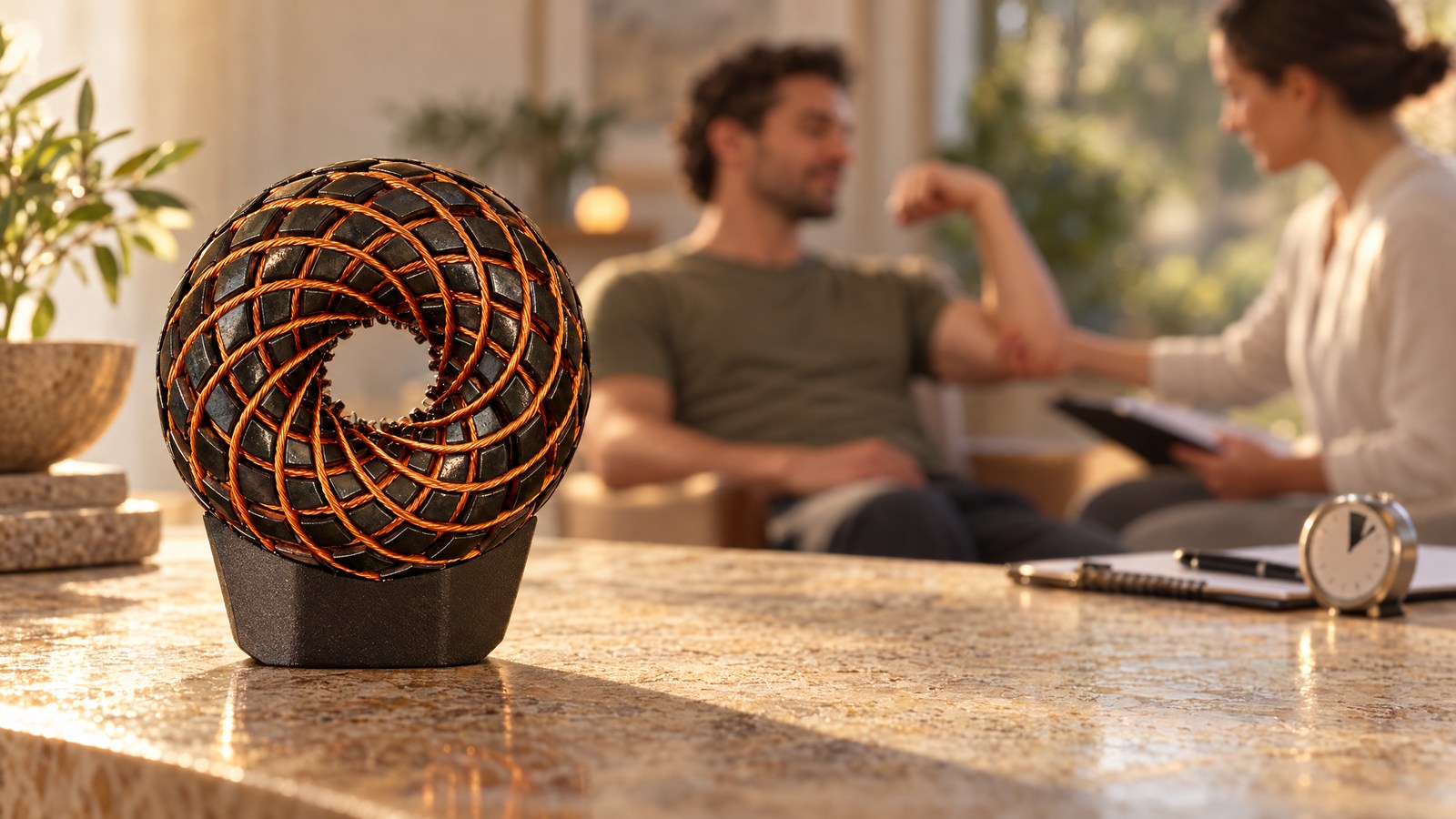
Want to see what your own PEMF setup records for you? Start with a cleaner question, a fixed setup, and a written log. The point is not to borrow someone else’s claim. It is to run a simple, repeatable active-versus-sham observation and see what your own records show across real days.
The iTorus 20-Minute Muscle Response Test is a practical personal-validation framework for PEMF Healing App users. The field version pairs one exact public program, Bicep Muscle Recovery and Strength 4X Sweep Energetics, with one consistent iTorus setup. It uses the same 20-minute session framework each day, repeated manual resistance observations before and after the session, two concealed sham days, a comparison arm, and a Day-8 no-session follow-up.
The important distinction is straightforward: this is a structured personal observation protocol. It helps a reader organize their own field notes around a specific product setup and program, then interpret the pattern with more clarity. It is not a diagnostic test, clinical trial, strength prescription, or proof that an app, a coil, or a single session changes muscle function.
What this guide gives you
- A plain-English explanation of what manual muscle testing can and cannot record
- A faithful, reader-friendly version of the seven-day iTorus protocol
- A simple reporting standard so active, sham, and no-change days all count
- An optional post-test wellness routine, kept separate from the formal test block
- A free download of the complete field protocol at the end of this article
Why this protocol is more useful than an unstructured before-and-after
Most self-experiments collapse several moving parts into one impression. The time of day changes. A workout happened earlier. The tester presses a little harder. The participant learns the task. A favorable result becomes memorable while an ordinary day disappears. That is not a character flaw. It is why measurement design matters.
This field protocol organizes the session around one public program link, one target-side biceps position, one comparison-side biceps position, the same testing order, and repeated trials. The helper, when available, determines whether the day is active or sham without telling the participant or tester. That design does not turn a personal log into clinical evidence. It does, however, reduce avoidable ambiguity and makes the final record more candid. Randomized condition order, masking, pre-specified outcomes, and complete reporting are recognized design features in single-case work.[8]

What a manual muscle test actually measures
Manual muscle testing, often shortened to MMT, is a hands-on clinical examination in which a tester observes whether a specific movement can be held against gravity or manual resistance. Common 0–5 grades are ordinal categories. They are not laboratory force readings in kilograms or newtons.[1]
That distinction changes the way a responsible reader uses this protocol. A different grade after a session is a recorded response under the protocol’s conditions. It is not, by itself, proof of increased muscle strength, a recovery effect, improved tissue status, or a treatment benefit. Position, stabilization, tester leverage, tester force, cueing, participant effort, fatigue, pain, learning, expectation, sleep, hydration, and time of day can all influence a manual result.
Research on conventional MMT shows that reliable assessments can be achieved in defined settings, but reliability varies by muscle action, procedure, patient group, scoring method, and examiner. It should be demonstrated for a use case, not assumed.[2] High agreement reported among trained, standardized examiners does not automatically transfer to an untrained household tester or a one-person wellness log.[3]
A critical boundary: This article uses a fixed biceps resistance observation. It does not use muscle response to diagnose disease, nutrient status, allergies, organ function, emotional state, or a hidden health condition. Standard musculoskeletal MMT and diagnostic-style Applied Kinesiology claims are not the same proposition.[4][5]
The exact program and the disciplined test block
For Days 1 through 7, use only the named primary program below. No companion app programs are added inside the test block. That is deliberate. Adding more sessions would add more changing variables and weaken the protocol’s central question.
| Program under test | How it is used | What stays fixed |
|---|---|---|
| Bicep Muscle Recovery and Strength 4X Sweep Energetics | One 20-minute session daily for Days 1–7, using the supplied protocol. | Target-side placement, time of day, tester, testing order, spoken cue, rest interval, and log format. |
The public program title tells a reader where to find the session. This article does not reproduce program-specific internal values, mappings, carriers, or design details. The practice is simple: link the exact public program, preserve a consistent user experience, and record what happened without pretending the name of a program is a clinical outcome.
Your own validation: one setup, one log, seven days
A 20-minute session lets you begin collecting your own observation data immediately. The seven-day structure gives that first session a useful context. Instead of chasing a different configuration every day, choose one setup, document it, and give the same approach a fair, repeatable run.
In the field version, that setup is the PEMF Healing App paired with an iTorus configuration. The same method can organize a reader’s experience with another compatible product, provided the reader documents the exact product, placement, settings, and routine and keeps them fixed during the test block. The protocol is strongest when it compares one consistent setup with its own blinded sham days, not when it mixes multiple devices and changing routines.
Your data, clearly organized: one linked program, one consistent iTorus or compatible setup, one 20-minute session window, repeated records, active and sham days, and a Day-8 follow-up. The outcome can be a pattern, a no-change finding, or ordinary variability. Each is useful information for your own wellness decision-making.
Set up the session before you test anything
- Choose the right question. This is for a non-injury wellness observation, not an acute arm problem or a question that needs diagnosis.
- Use two people. The participant and tester should be different people. A third helper is strongly preferred for concealed active and sham-day preparation.
- Standardize the position. Use the same chair, posture, elbow position, resistance direction, hand placement, and tester stance every time.
- Write the setup sheet first. Record the time window, dominant side, target side, coil placement, tester identity, and any planned optional grip device before Day 1.
- Use the same verbal cue. A short cue such as “hold this position” is more repeatable than motivational coaching that changes from trial to trial.
- Keep the condition concealed. On sham days, the helper preserves the same visible routine while disabling output according to the protocol. Participant and tester record a private guess only after measurements are complete.

The seven-day iTorus muscle-response schedule
For every test day, the protocol calls for three manual-test trials before the session and three after it for the target-side biceps and comparison-side biceps. The median is more informative than a single favored attempt because it makes a visibly inconsistent set of trials harder to ignore. If an optional grip dynamometer is used, use the same device, position, handle setting, instructions, trial count, and rest pattern every day. Grip force is a separate measure from biceps resistance and should not be treated as interchangeable with it.[6]
| Day | Session | Record before unmasking |
|---|---|---|
| 1 | Primary program, 20 minutes | Target, comparison, and indicator trials; any workout, unusual fatigue, pain, or setup deviation. |
| 2 | Primary program, 20 minutes | The same records plus participant and tester condition guesses. |
| 3 | Primary program, 20 minutes | Exact same position, test order, cue, and optional grip procedure. |
| 4 | Primary program, 20 minutes | Record all three trial values, not only the best one. |
| 5 | Primary program, 20 minutes | Document any broken blind, visible indicator, sound, or helper cue. |
| 6 | Primary program, 20 minutes | Keep the same time window and record protocol deviations honestly. |
| 7 | Primary program, 20 minutes | Complete the full log before looking at the helper key. |
| 8 | No session | Repeat the same measurement time and method, then unmask the active and sham schedule. |
How to read the completed log without over-reading it
At the end, compare the day-level medians rather than relying on a single moment. Ask four practical questions:
- Did the target-side pattern look different from the comparison side on active and sham days?
- Did the result appear on multiple days, or only on a day with unusual sleep, activity, fatigue, or expectation?
- Were participant and tester guesses correct more often than chance, suggesting the blind may have been compromised?
- Does the Day-8 no-session entry look similar, different, or simply variable?
A complete no-change log is still useful. A result that occurs on active and sham days, or on only one day, is a reason to document uncertainty rather than edit the narrative. A short immediate difference does not establish a clinically meaningful change. Even for grip dynamometry, the literature does not supply one universal threshold that turns a small pre/post difference into a meaningful clinical conclusion.[7]
Likewise, two sham days improve the logic of the experiment but do not prove a device-specific effect. Session context, expectation, learning, fatigue, and ordinary fluctuation remain part of what the log can capture.[9] This is why the most valuable field data includes every active day, every sham day, and every deviation.
Why a device-specific result cannot be borrowed from another PEMF study
Electromagnetic stimulation research is not one uniform intervention. Different systems use different field characteristics, waveforms, placements, session schedules, target tissues, populations, and intended uses. Evidence from one device or indication cannot be carried across automatically to a consumer iTorus setup, a mobile-app program, or a short personal biceps observation.[10][11]
That is not a reason to abandon careful observation. It is a reason to keep the claim as precise as the measurement: “Under this setup, the recorded post-session manual-test grade did or did not differ from the pre-session grade.” That sentence leaves room for further research without converting a personal log into a health claim.
Optional objective layer: grip readings
If a validated grip dynamometer is available, it can add a numeric record to the log. It should be reported as a separate outcome, for example: best of three grip readings in kilograms using the same device and fixed protocol. It is more quantitative than an examiner-assigned 0–5 grade, but it is not a direct biceps measurement and it still depends on consistent posture, familiarization, instructions, rest, and device handling.[6]
The most transparent report is a small table containing all trials, median or pre-specified summary value, active or sham condition, condition guesses, and notes. Do not select only a favorable day. Do not convert three repeated trials into three independent participants.
Safety and referral come first
Do not use this protocol to test through an acute arm injury, suspected biceps tear, severe or worsening pain, marked bruising or swelling, visible deformity, new loss of function, numbness, tingling, cold or discolored skin, or any new neurologic symptom. A pop or snap followed by pain, bruising, a new upper-arm bulge or hollow, or difficulty bending the elbow or turning the palm up deserves clinical assessment rather than repeated resisted testing.[14][15]
Sudden one-sided arm weakness or numbness with facial droop, speech difficulty, vision change, dizziness, or loss of balance is an emergency. Call emergency services immediately and note the time symptoms began.[16]
Follow the exact device instructions. Stop the session for pain, dizziness, palpitations, nausea, unusual sensations, or other concerning symptoms. People with implanted electronic medical devices should obtain device-specific guidance from the treating clinician and the implant or device manufacturer before exposure. General field guidance does not replace an individualized implant-interference assessment.[12][13]

Optional post-test wellness routine, only after the formal protocol is complete
Do not add this routine during Days 1–8. After the Day-8 follow-up, take a full seven-day pause before choosing any optional follow-on routine. The pause preserves a clean boundary between the test block and ordinary wellness listening. If you begin the optional seven-day routine after that pause, use the primary program first, then two linked companions, and leave ten quiet minutes between sessions. Follow each program’s displayed in-app runtime. This is consumer wellness use, not a treatment plan and not an extension of the muscle test.
Pause a full week again before any optional repeat. If wellness use is uncomfortable or creates concerning symptoms, stop rather than trying to push through a planned schedule.
Device context and optional resources
The formal protocol uses an iTorus setup as its session context. The same basic discipline matters whether the reader uses an iTorus i2, an iTorus i5, or another compatible setup: document the exact configuration, keep it consistent while testing, and do not equate a consumer-wellness session with a clinically investigated stimulation system.
Some readers enjoy multimodal wellness rituals. A haptic wearable can be used as a separate sensory layer, and an imprinter can be used for personal routine practices. Neither should be added inside the formal muscle-test block, and neither turns the log into evidence of a medical outcome. If considering combinations, use one change at a time and retain the same conservative safety boundaries.
| Resource | Reader use | Link |
|---|---|---|
| Frequency Healing App | Find the linked primary and companion program pages. | Explore the platform |
| iTorus i2 | Personal-space iTorus collection. Follow product instructions and safety information. | View iTorus i2 |
| iTorus i5 | Room-scale iTorus collection. Follow product instructions and safety information. | View iTorus i5 |
| Woojer Vest 4 | Optional haptic listening layer, used separately from the formal test block. | View Woojer Vest 4 |
| Metatronic Flower of Life Frequency Imprinter | Optional personal routine tool, not a diagnostic or medical device. | View the imprinter |
Affiliate disclosure: Some resource links may be affiliate links, meaning PEMF Magazine may receive a commission at no added cost to the reader. Editorial claim boundaries remain the same whether or not a reader uses a linked resource.
Related Articles
- Spinal Fusion Bone Stimulators: FDA Status, Evidence & Safety
- Calminity vs PEMF Healing: Static Frequency vs BioPhi Programs
- Vascular Flow & Endothelial Support: Research and 8-Phase Guide
- The Evidence-Based Beginner’s Guide to PEMF Therapy
References
- Shirley Ryan AbilityLab. Manual Muscle Test.
- Cuthbert SC, Goodheart GJ. Reliability of manual muscle testing: A systematic review.
- Hough CL et al. Inter-rater reliability of manual muscle strength testing in ICU survivors and simulated patients.
- Haas M et al. Disentangling manual muscle testing and Applied Kinesiology.
- Reliability of Manual Muscle Testing in Applied Kinesiology: A Systematic Review.
- Stark T et al. Considerations and Practical Options for Measuring Muscle Strength.
- Bohannon RW. Minimal clinically important difference for grip strength: a systematic review.
- Vohra S et al. CONSORT extension for reporting N-of-1 trials.
- Vase L et al. Responses to the sham treatment versus expectancy effects.
- Bassett CAL. Pulsed electromagnetic field applications: a corporate perspective on clinical applications.
- Pulsed Electromagnetic Therapy: Literature Review and Clinical Applications.
- ICNIRP. Guidelines for limiting exposure to time-varying electric and magnetic fields, 1 Hz–100 kHz.
- FDA. Magnets in consumer electronics may affect implanted medical devices.
- Cleveland Clinic. Biceps Tendon Rupture (Torn Biceps).
- Mayo Clinic. Strains, sprains and tears of the upper arms.
- CDC. Signs and Symptoms of Stroke.
Free download: The complete 20-Minute Muscle Response Test protocol
Ready to run the field protocol exactly as structured? Download the full 17-page PDF with the setup sheet, concealed-condition instructions, day-by-day logs, Day-8 follow-up, and complete reporting checklist.
Explore PEMFHealing.app
Your companion for structured frequency programs and progress tracking.
Why full spectrum frequencies can feel stronger than a single tone
- Broader coverage across biological windows, not a narrow peak.
- Harmonics and sidebands can support entrainment and coherence.
- People vary by tissue state and time of day, so spectrum raises the chance of a match.
- Lower adaptation risk compared to repeating a single tone for long periods.
Dual channel vs single channel
- Two independent channels can run complementary programs at once.
- Phase and field options may create a smoother perceived field.
- Target local and systemic aims together, for example focus plus relaxation.
Why we use multi modality, not only Rife
Complex systems benefit from more than one input. We layer modalities to address different pathways and timescales.
- WBV for circulation and lymph support
- VibroAcoustics for relaxation and coherence
- Pro Rife and Ultra Rife targeted frequency sets
- ElectroHerbalism mild field patterns with botanicals
- NeuroCeptors gentle neuromodulation for calm and focus
- Biophotonics light based cellular signaling support
- Scalar field coupling for subtle energy work
- Plus PEMF, photobiomodulation, breathwork, HRV awareness, and more
Our ecosystem
-
Imprinter imprint supportive signatures into water, supplements, crystals, or pendants.
Metatronic Flower of Life Dual Frequency Imprinter -
iTorus i2 portable PEMF coil for on the go sessions.
iTorus i2 -
iTorus i5 higher output portable PEMF.
iTorus i5
Disclosure: Some links may be affiliate. If you purchase, we may receive a small commission at no extra cost to you.
Disclaimer: This content is for informational purposes only and is not medical advice. Always consult a qualified healthcare professional before starting any new therapy or using frequency based devices.
Related articles
- Malachite Heart Stone: A 12-Part Heart Circle Guide
- Vogel Crystal Light: The 7-Color BioPhi Collection Explained
- 432 Hz vs 440 vs 444: The Math Verdict on 13 Tunings
- Calminity vs PEMF Healing: Static Frequency vs BioPhi Programs
- Vascular Flow & Endothelial Support: Research and 8-Phase Guide
- Art Tawanghar’s 2015 AI Wellness Loop: Soaak, WHOOP & Endel