
10-Organ BioPhi 369 Matrix: Research & Harmonic Wellness
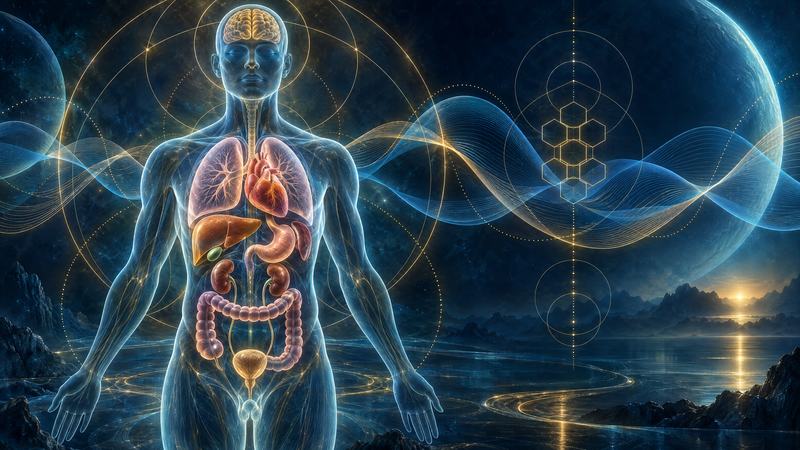
A living body is not one note. Why should a whole-body listening experience be built as though it were?
Nine interconnected layers. Six phases. Ten organ-inspired themes. The new BioPhi 369 Matrix brings a more ambitious compositional idea to frequency wellness: organize an experience around relationships, progression and the body’s changing rhythms, rather than reduce an organ to a number on a list.
What is it? 10-Organ Support & Renewal BioPhi 369 Matrix 6-Phase Harmonic Resonance Energetics is a 33-minute, research-inspired stereo composition for general wellness listening. Its innovation is the integration of organ-related research themes with an evolving harmonic design. The six phases and nine layers describe the listening architecture, not nine separate medical outputs or a clinically established organ-renewal treatment.
Available through the PEMF Healing Platform, this programme invites a different question: how can a carefully composed sensory experience make biological complexity easier to understand, and give people a meaningful space for attentive listening?
The big idea: from isolated organs to coordinated living systems
The lungs adjust ventilation in response to chemical and mechanical feedback. The heart changes its pacing as demand changes. The stomach has electrical timing networks that help organize muscle activity. The kidneys use feedback to stabilize filtration across a range of pressures. These organs are not independent machines running at permanently assigned frequencies. They participate in a body that continually adjusts to sleep, activity, meals, emotion and the surrounding environment. [1] [5] [18] [25]
That is why a systems-level perspective is so compelling. The useful unit of understanding is often not the organ alone, but the interaction between cells, tissue mechanics, neural control and feedback. A composition can draw inspiration from these relationships while remaining a composition.
Here, sonification means representing research-derived ideas through sound. It is an artistic translation of selected biological information, not a recording of the listener’s organs and not a live measurement of their condition. The programme’s public description concerns a prepared listening experience; it does not establish closed-loop physiological feedback.
This distinction gives the innovation a clear identity. PEMF Healing Labs is exploring a richer language for wellness sound design: time-varying harmony, interacting textures and a deliberate listening arc. The exciting advance is architectural. Its clinical significance is a separate question that would require studies of this exact programme.
Which ten organs are included?
The ten categories are lungs, heart, brain, liver, kidneys, spleen, stomach, large intestine, gallbladder and urinary bladder. The paired lungs count as one category, and the paired kidneys count as one. The gallbladder and urinary bladder are different organs and should never be conflated.
The research behind these themes is deliberately heterogeneous. Some sources describe physiological timing. Others record electrical activity, pressure or force. Elastography studies measure mechanical tissue properties. That diversity is the interesting part: it reveals several ways in which living systems organize and respond.

1. Lungs: rhythm generated by a feedback network
Breathing feels simple until we examine its control system. Brainstem networks generate and shape respiratory activity, while feedback about carbon dioxide, acidity, oxygen and lung stretch adjusts the amount of ventilation. Neural commands recruit the diaphragm and other respiratory muscles according to demand. [1] [2] [3]
A commonly cited resting-adult clinical range is 12 to 20 breaths per minute, but this is a reference range, not a universal rhythm. Rate and depth change with activity, age, sleep, stress, illness and the conditions of measurement. At rest, inhalation is active muscle work; exhalation is usually largely the release of elastic recoil. [1] [3]
The creative lesson is the relationship between activity and release. A respiratory theme can invite awareness of natural breathing without asking the listener to force an externally imposed rate. The relevant biological rhythm is a regulated neural-muscular cycle, not a special audible tone hidden inside the lungs.
2. Heart: electrical pacing that remains responsive
The heart’s normal pacemaker is the sinoatrial node. Its cells depolarize spontaneously, initiating impulses that move through the cardiac conduction system and coordinate contraction. Autonomic influences continually modify this activity: parasympathetic input slows pacing, while sympathetic input increases rate and supports greater demand. [5] [6] [7]
A calm adult resting pulse is often described as 60 to 100 beats per minute. That clinical reference is not an ideal target for every person. Fitness, medication, temperature, posture, sleep, disease and emotional state all matter. Heart-rate variability, or HRV, describes variation between successive beat intervals; interpreting it requires the recording method and physiological context. [4] [7]
The insight is not that a healthy heart is perfectly repetitive. It is that cardiac timing is responsive. For the BioPhi concept, this makes the heart an especially useful theme for moving beyond a rigid, one-number view of physiology. HRV remains a contextual measurement, not a simple score for organ renewal.
3. Brain: oscillations interpreted in context
Electroencephalography, or EEG, records voltage fluctuations at the scalp associated with brain activity. Frequency bands help describe those recordings, but the meaning of a band depends on age, recording location, wakefulness, sleep and task. Theta activity, for example, is prominent during drowsiness and early sleep in standard clinical descriptions. [8]
A 2024 review of developmental EEG research shows why simplistic labels can mislead. Resting theta and task-related theta had different associations with cognitive performance in children and adolescents. The same band label did not signify one universal mental benefit. Spectral power also contains broadband, non-oscillatory contributions, so a power increase does not automatically identify a single discrete oscillator. [9]
Binaural listening adds an auditory dimension. When different tones reach the two ears separately, a listener may perceive a beat related to their frequency difference. That percept is distinct from an EEG rhythm. A 2023 systematic review found inconsistent evidence for binaural-beat EEG entrainment across 14 studies. The strongest public framing is therefore an intentionally designed auditory experience, rather than a guaranteed brain-state switch. [10]
4. Liver: what mechanical waves reveal about tissue
The liver section introduces magnetic resonance elastography, or MRE. A controlled external vibration produces shear waves in tissue. MRI records the resulting motion, and mathematical analysis estimates mechanical properties such as stiffness. Clinicians and researchers use these measurements to investigate liver disease, including fibrosis. [13] [14] [15]
One reference study examined 102 healthy young adults using a 60 Hz diagnostic driver and reported average liver stiffness of 2.14 ± 0.28 kilopascals. A separate multifrequency feasibility study in ten healthy volunteers reported a different mechanical endpoint and value. These findings belong to their imaging protocols and populations; they are not universal constants of liver tissue. [11] [12]
The important advance is that tissue can be assessed through its response to a controlled mechanical input. The vibration setting is chosen for measurement. It does not identify a natural liver-healing frequency, and the study does not show that listening to a numerically similar sound produces the same response. The compositional inspiration is tissue responsiveness, not transfer of an imaging prescription.
5. Kidneys: feedback, filtration and the importance of delivery
Kidney function includes glomerular filtration and regulation of the internal fluid environment. Renal autoregulation helps stabilize blood flow and filtration over a defined pressure range through mechanisms that include vascular myogenic responses and tubuloglomerular feedback. This is biological regulation in a particularly concrete form: local sensing changes the response. [17] [18]
Mechanical imaging supplies a different perspective. A prospective abdominal MRE study in eleven healthy volunteers assessed wave delivery and repeated stiffness measurements across abdominal organs. Kidney measurements depended on appropriate delivery of mechanical waves near the kidney being examined. The sample was small, and the combined imaging approach was not optimized for all aspects of renal assessment. [16]
That finding reinforces an essential engineering principle: the delivery pathway matters. A signal’s name or frequency alone does not determine its tissue effect. Renal stiffness is also a different endpoint from filtration, blood flow or recovery. The kidney theme can evoke regulated balance without confusing a mechanical image with demonstrated improvement in kidney function.
6. Spleen: blood filtration and immune organization
The spleen is both a blood-filtering organ and a secondary lymphoid organ. Red pulp helps remove aged or damaged red blood cells and recycle iron. White pulp and associated blood-facing immune regions organize responses to blood-borne antigens, involving antigen presentation, T cells, B cells and antibody production. [20]
In the ten-volunteer multifrequency MRE study, the spleen was mechanically stiffer than the liver within that cohort. A later diagnostic study involving 45 people with chronic liver disease and 16 healthy volunteers found strong liver-fibrosis staging performance, but only a weak relationship between splenic shear-wave speed and fibrosis stage. Splenic stiffness is not a direct measure of immune effectiveness. [11] [19]
A separate research frontier is spleen-targeted focused ultrasound. A 2023 study in healthy people reported a transient change in endotoxin-stimulated TNF production in blood tested outside the body. A 2019 inflammatory-arthritis study was conducted in mice. These are exposure-specific neuromodulation experiments, distinct from elastography and ordinary listening; a registered human feasibility study provides a further research trail, not proof of benefit from this programme. [21] [22] [23]
The spleen’s value in the ten-organ concept is its connection between circulation and immune organization. It broadens the story beyond the familiar heart-and-brain pairing.
7. Stomach: a genuine bioelectrical timing system
The stomach offers one of the clearest examples of biological electrical coordination. Interstitial cells of Cajal are specialized pacemaker cells that generate slow waves. These waves propagate through cell networks and influence smooth-muscle excitability through electrical coupling and calcium-dependent processes. An electrical slow wave is not itself a muscle contraction, but it helps organize the conditions under which contraction can occur. [25] [26]
In a 2010 high-resolution mapping study, researchers recorded electrical activity directly during surgery in twelve patients whose stomachs were judged normal. The measured dominant rhythm averaged 2.83 ± 0.35 cycles per minute. Multiple wavefronts propagated toward the distal stomach, and conduction speed differed between regions. This was human physiological mapping, not an audio intervention. [24]
What makes the finding compelling is organization across space. The stomach is not merely pulsing at a rate; electrical activity travels through an anatomical network. For a harmonic composition, that is a richer inspiration than an isolated frequency label. The 2021 translational review places these observations within the gastric conduction system in health and disease. [25]
8. Large intestine: several motor patterns, not one clock
Colonic activity includes movements that mix contents, move them forward and, in some circumstances, propagate backward. High-resolution manometry records pressure changes inside the colon, allowing researchers to distinguish these patterns. It does not directly measure membrane voltage. [27] [31]
In ten healthy adults, a study comparing fasting and post-meal recordings identified several propagating pressure-pattern types. Many cyclic and short single patterns were retrograde, and meal ingestion changed the pattern distribution. Another study examined 34 surgically removed distal-colon segments in a laboratory bath, identifying spontaneous contractions and responses to stimulation. The intact human study and the excised-tissue study answer different questions. [27] [28]
Separate electrophysiology studies recorded electrical rhythms in human rectosigmoid tissue, including changes after pharmacological stimulation. Reviews connect these observations to smooth-muscle and pacemaker-cell physiology while emphasizing regional variation. [29] [30]
The compositional lesson is patterned diversity. A system can be organized without being uniform. That principle supports the programme’s wider interest in interacting rhythms rather than a claim that the entire large intestine runs on one fixed therapeutic frequency.
9. Gallbladder: coordination with meals and fasting
The gallbladder stores and concentrates bile between meals. Nutrient-related signals, especially cholecystokinin or CCK, promote contraction and coordinate bile delivery to the duodenum. During fasting, gallbladder filling and partial emptying also relate to the migrating motor complex, the recurring gastrointestinal activity pattern between meals. [34] [35]
Two small human studies are particularly relevant. One followed ten healthy fasting men using scintigraphy and pressure recordings. Another followed nine fasting volunteers using ultrasound and manometry. Both found relationships between gallbladder dynamics and phases of interdigestive activity, with considerable variation between observations. They did not establish one invariant gallbladder cycle. [32] [33]
For this programme, the gallbladder’s rhythmic representation is an illustrative compositional assumption inspired by fasting-linked physiology. That is a transparent creative choice. It evokes participation in a broader digestive cycle rather than claiming to reset bile release or synchronize the listener’s gallbladder.
10. Urinary bladder: storage, sensing and coordinated release
The urinary bladder must store urine at relatively low pressure and then switch to coordinated emptying. The detrusor muscle, sensory information from the bladder wall and neural control all participate. Spontaneous activity may contribute to tone and filling sensation, but contractions are not uniform across the entire wall. [37] [38] [39]
The dossier’s principal rhythmic-contraction source examined nine surgical tissue samples outside the body and separately reviewed one hundred urodynamic studies. Most tissue donors had underlying pathology. Of 91 interpretable urodynamic files, only twelve had a selected pressure-wave signal independent of abdominal activity; most of that small subgroup also had detrusor overactivity. [36]
This research is informative precisely because it identifies a specific signal in a specific setting. It is not a healthy-population bladder clock. The broader theme for BioPhi is the relationship between storage and release, understood as a coordinated function rather than a sound frequency assigned to every bladder.
Bioelectricity: the real science underneath the bigger vision
Bioelectricity is more than the electrical activity of nerves. Cells maintain membrane-voltage differences through ion channels and pumps. Gap junctions allow electrical and chemical communication between neighboring cells. Tissue-level patterns of electrical state can interact with signaling pathways and gene expression. [50]
Research summarized by Levin, Pezzulo and Finkelstein describes how endogenous bioelectric networks participate in development, growth, patterning and regeneration, drawing mainly on animal and cell models. Voltage changes can be translated into downstream processes involving calcium and other signaling mechanisms. Electrical state and gene activity can also influence one another through feedback. [50]
This supports a serious scientific thesis: some future interventions may work by influencing the information and control systems that guide tissue behavior, not only by acting on an organ as a finished structure. The shift is toward understanding how the body coordinates its own processes.
It is an expansion of medicine’s toolkit, not a reason to discard organ-level care. A damaged organ still needs appropriate assessment and treatment. Upstream signaling research asks an additional question: which local or distributed control processes could be measured and deliberately influenced?
For the BioPhi 369 Matrix, this science supplies a conceptual horizon. The programme draws attention to a body coordinated through signals and relationships. Demonstrating direct control of non-neural repair networks through this recording would require evidence beyond the developmental and regenerative literature.
The autonomic connection: a plausible sensory pathway
The autonomic nervous system helps regulate cardiac activity and many other ongoing bodily functions. Listening engages perception, attention and emotion; in some contexts those responses are accompanied by changes in physiological stress measures. That gives wellness listening a reasonable systems-level role to investigate. [7] [51]
A review and two meta-analyses covering 104 randomized trials and 9,617 participants found overall effects of music interventions on psychological and physiological stress-related outcomes. The interventions were varied, so the findings should be understood within that broad scope. [51]
A narrower meta-analysis of acute stress recovery in healthy participants, covering fourteen experimental studies and 706 people, found no statistically significant overall benefit. Different questions and study designs produced different conclusions. Taken together, the evidence favors context-sensitive discussion of listening rather than an automatic relaxation or repair claim. [52]
The practical opportunity is still worthwhile: a composition can provide a structured period for attention, breathing awareness and a pause from competing inputs. Whether this particular design reliably changes autonomic measures is an empirical question, not something a phase count can establish.
FDA research: the genuine connection to signal-based medicine
Precisely engineered physical signals already have established medical uses. The evidence becomes meaningful when we name the device, the delivery method, the population and the intended use. The FDA distinguishes premarket approval from 510(k) clearance; registration or a shared frequency is not an interchangeable authorization. [57]
Resoundant MRE: FDA-cleared diagnostic vibration
The FDA’s K201389 record clears the Resoundant Acoustic Driver System for generating acoustic vibrations during MRI to assess tissue elasticity as part of MRE. This is the clearest regulatory connection to the mechanical-imaging research discussed for the liver, spleen and kidneys. The labeled purpose is diagnosis through measurement, not treatment of ten organs. [43]
The Echosens FibroScan record K223902 likewise concerns liver measurements and, for the specified model, spleen stiffness as aids to assessment, diagnosis and monitoring. It is a separate elastography technology, not evidence that a listening composition reproduces either diagnostic method. [44]
Vivistim: FDA-approved nerve stimulation paired with rehabilitation
The MicroTransponder Vivistim Paired VNS System received PMA approval under P210007. Its indication concerns vagus-nerve stimulation paired with rehabilitation to improve specified upper-extremity deficits after chronic ischemic stroke. An implanted system and a defined rehabilitation intervention are part of that authorization. [40] [41]
The lesson for the broader signaling thesis is important: the timing and delivery of an intervention can matter alongside the activity it is paired with. That principle is interesting for future research, but the approval does not transfer to consumer sound or a meditation routine.
Cervical-Stim: FDA-approved PEMF for a defined orthopedic use
The FDA approved the Cervical-Stim Model 505L under P030034 as a non-invasive pulsed electromagnetic bone-growth stimulator used as an adjunct to cervical fusion in patients at high risk of non-fusion. This establishes a particular medical application of a particular PEMF device, not a general organ-renewal indication. [42]
Where does that leave the ten-organ programme? The source material provided for this article does not identify a device, FDA decision number or traceable approved ten-organ treatment protocol from which this recording can be verified as derived. The defensible description is research-inspired design informed by biological and mechanical-imaging concepts. These FDA examples illuminate the field; they are not regulatory endorsements of BioPhi 369.
Nine layers: an interacting composition, not a frequency checklist
The nine-layer design is best understood collectively. A layer is a component of digital sound design that contributes to the combined experience. The listener receives the resulting composition, not nine independent treatments directed at nine locations.
That change in emphasis matters. Adding more components is not automatically innovation. The compositional challenge is deciding how the combined material behaves: whether the texture feels coherent, whether changes remain comfortable, and whether a listener can follow the experience without being overwhelmed.
BioPhi 369 places its ten organ themes inside a six-phase, 33-minute stereo work. The design is organized over time rather than presented as a catalogue of unrelated tones. Harmonic relationships, rhythmic modulation and the changing overall texture give the listener more to engage with than a single continuously sustained sound.
The public explanation can be substantial without becoming a reconstruction manual. It can describe the listening intention, the research contexts and the importance of relationships. The exact implementation is not needed to understand why this is a different kind of composition.
Six phases: progression is part of the experience
A phase is a section of the listening work, not a claim that one organ has completed a repair step. Six phases provide an organized progression across the session. They should not be interpreted as six medical stages or a schedule for visiting organs one by one.
At the level of listener experience, it is useful to think in terms of an opening, development and closing. These are editorial descriptions of a listening arc, not the internal phase names. The opening offers a way into the experience; development makes room for evolving texture; closing gives the listener a natural opportunity to reorient.

3–6–9 and sacred geometry: a tool for noticing relationships
The appeal of 3–6–9 is that it encourages attention to grouping, subdivision and recurrence. Three can suggest a beginning, middle and end. Six allows another level of subdivision. Nine offers a larger pattern of return. In BioPhi 369, this is a compositional and symbolic lens for organizing a work.
Sacred geometry adds a contemplative vocabulary of proportion, symmetry and repeating form. It can help a listener think about balance and relationship, while the formal mathematics remains specific: symmetry means that an object retains a defined property under a transformation such as rotation or reflection. Threefold or sixfold symmetry are examples, not the only forms of symmetry. [47]
The chair and the right angle: what the example really teaches
Imagine building a chair. You must consider how the legs, seat and back relate, how the chair supports a body and how it remains stable. Geometry is indispensable to describing those relationships. A right angle is one especially useful relationship in construction.
But the right angle is the same geometry whether we write it as 90 degrees or π/2 radians. The number changes with the unit; the relationship does not. A reclining chair can also work without a 90-degree seat-to-back angle. The useful insight is the importance of form, support and proportion, not biological dependence on the decimal digits 3, 6 and 9. [45] [46]
What would a world without those digits look like? If we simply used another numeral system, the world would remain physically the same. If we imagined a world without geometric relationships, we would be imagining away the structure by which shapes and positions are described. Those are different thought experiments. Digital-root patterns involving nine also depend on the base used to write numbers. [49]
This makes the design philosophy more interesting, not less. Numbers are tools for understanding relationships. A framework earns its value when it helps us notice and work with those relationships, without needing to declare itself the sole law behind life.
Harmonics and the meaning of new “dimensions”
In the standard physical definition, harmonics are integer multiples of a fundamental frequency. Which resonant modes occur depends on the system and its boundary conditions. A geometric motif alone does not establish resonance in an organ. [48]
In composition, related frequencies can provide an organizing structure for the combined sound. “Coherent” here describes intentional compositional relationships, not a measured state of cellular coherence or quantum coherence.
New dimensions can be a useful description of the listener’s growing awareness of pitch, texture, timing, spatial impression and touch. These are perceptual and design dimensions. Understanding more of a work can reveal more to attend to, without implying verified access to additional physical planes.
Why do churches have an “organ”? Sacred architecture, sacred sound and the body
We have organs inside the body, and a church may have an organ inside its sanctuary. That shared word opens a compelling question: what happens when we think of the body, the instrument and the building as organized relationships rather than isolated parts?
The connection begins with language. The Greek word organon means an instrument, implement or tool for doing something. The ancient Greek lexicon records both bodily or sensory organs and musical instruments within this word family. The common idea is a means through which a larger whole performs a function. [62]
Why we have organs: specialization in service of the whole
An organ is an anatomically distinct structure made from two or more tissue types that performs one or more physiological functions. Cells cooperate in tissues; tissues form organs; organs cooperate in systems. This division of labor makes complex bodily functions possible. Structures suited to exchanging gases do a different job from structures suited to processing food, moving blood or removing waste. Many organs also contribute to more than one system. [63]
That is the useful sense in which your organs form an ensemble. Their roles differ, but their work belongs to one living body. Calling them an ensemble is a metaphor for cooperation, not a claim that each organ has one musical note. It also explains why the 10-Organ BioPhi concept is more interesting as a whole-body compositional framework than as a list of ten disconnected tones.
The church organ: an ancient instrument adopted into sacred life
The pipe organ did not begin as a Christian medical instrument. Its earliest known mechanical predecessor, the hydraulis, was invented by Ctesibius of Alexandria in the third century BCE. Air supplied the pipes; water helped regulate the air pressure. It was used for public entertainment long before Christianity. Britannica describes organ building in Europe by the eighth century and an established association with the church from the tenth century. [64] [65]
So why does a church call its instrument an organ? Because the musical name belongs to that older instrument-and-tool word family. The history supports a shared root, not a story that church organs were named to heal corresponding bodily organs. The richer connection is functional: many sounding parts are brought together into an expressive whole, just as bodily organs contribute different functions to one organism. [62] [63] [65]
When the sacred building becomes part of the sound
A pipe organ makes geometry audible. Its pipes contain vibrating air columns, and their construction helps determine the sounds they produce. Once that sound leaves the instrument, the surrounding building changes how it reaches the listener. The room is not merely a container. Its size, surfaces and layout contribute reflections and reverberation, the continuing decay of sound after the source stops. [65] [66] [67]
Research on Notre-Dame de Paris makes this relationship tangible. Acoustic measurements and calibrated models have been used to investigate how the cathedral’s changing configurations, materials and organ placements shape its sound. Architecture and musical experience interact through measurable acoustics. A sustained phrase heard in such a space is therefore an encounter with both the instrument and the room. [66]
Sacred geometry can give this physical design a spiritual vocabulary. At the Cathedral of Christ the Light in Oakland, two intersecting arcs create a plan that evokes a fish, a Christian symbol. Those curved surfaces also presented an acoustic challenge: concave geometry can focus sound unevenly. Acoustic design recommendations addressed that behavior. This is a concrete example of symbolism and engineering sharing the same building, with each doing a different job. [67]
The lesson is not that every sacred shape produces the same effect. It is that proportion, material, placement and timing matter to the experience. Sacred architecture can invite contemplation through its meaning, while its physical form shapes what a person actually hears.
Sacred sound and the body’s rhythms: a real physiological bridge
Prayer and chanting offer a more direct bridge between sacred practice and physiology because the person producing the sound also breathes. In a comparative study of 23 healthy adults, Bernardi and colleagues found that reciting the Latin Ave Maria or a yoga mantra slowed breathing to around six breaths per minute and strengthened the synchronization of measured respiratory and cardiovascular rhythms. Baroreflex sensitivity, a measure of the heart-rate response to blood-pressure changes, also increased during the experiment. [68]
This finding gives the connection substance without requiring a mystical explanation. A meaningful vocal phrase can organize an exhalation. Repetition can organize timing. Breathing and cardiovascular regulation can interact. The study concerned short-term responses in healthy participants; it did not test the regeneration of ten organs or establish a universal law of 3–6–9. Its significance is the measurable meeting of ritual, rhythm and bodily regulation. [68]
The broader music-intervention literature also examines stress-related outcomes, providing another research context for using sound in a restorative wellness routine. The experience depends on the intervention and listener, rather than on a sacred label alone. [51]
“Sacred sounds = sacred healing”: a meaningful way to understand the phrase
In this article’s spiritual and wellness framing, sacred healing can mean a return to calm, meaning and a felt sense of wholeness. A sacred building offers a place for attention. Its acoustics shape the sound. Music or prayer gives the experience a temporal structure. The listener brings breath, emotion and personal meaning. Together, these elements can become a restorative practice alongside ordinary health care, rather than a claim that a church organ or architectural pattern repairs a particular bodily organ.
This is the connection worth carrying into 10-Organ Support & Renewal BioPhi 369 Matrix 6-Phase Harmonic Resonance Energetics. Its six phases and nine interacting layers provide a contemporary compositional framework for exploring relationships, progression and whole-body attention. The cathedral is an inspiring analogy for integrated design, not a clinical validation of the programme.
The body has organs because living functions require organized cooperation. The church organ brings sounding parts into one musical instrument. Sacred architecture brings space, proportion and meaning into the encounter. BioPhi draws a creative lesson from that shared emphasis on relationship: design a listening experience as a connected whole, rather than reducing it to an isolated number.
Beyond the static-tone mindset: why evolution over time matters
A sustained tone and a phased composition are different listening formats. One foregrounds repetition. The other can organize continuity and change across a session. This distinction is concrete enough to discuss without claiming that a dynamic composition has solved every biological adaptation problem.
Habituation is a reduction in response to repeated stimulation; neural adaptation and stimulus-specific responses are studied across human and animal neuroscience. These processes can be useful, helping an organism allocate attention and detect changes. They are not inherently evidence that cells are becoming damaged or that a particular therapy has stopped working. [53]
For sound design, the relevant question is how much sameness a listener experiences and how change is introduced. Evolving texture and phase progression provide compositional possibilities that a single unchanging tone does not. Their perceptual effects depend on the sound and the listener; avoiding cellular adaptation or producing superior clinical outcomes would need direct comparative testing.
The “end of the Rife era” is most defensible as a shift away from the one-frequency-for-one-condition mindset in consumer wellness discourse. It is not a demonstrated medical transition in which this programme replaces an established Rife treatment. BioPhi’s case is stronger when it is made on its actual design: layered sound, organized progression and a richer interpretation of biological complexity.
| Design question | Single sustained tone | BioPhi 369 public design |
|---|---|---|
| How does it unfold? | One sustained acoustic element by definition. | A 33-minute composition with six phases. |
| What is combined? | A minimal tonal texture. | Nine interacting sound-design layers, described collectively. |
| How is physiology represented? | A number can be presented without its measurement context. | Ten organ themes can be explained through their distinct research contexts. |
| What is the opportunity? | A simple listening reference. | A more elaborate experience of progression, harmony and texture. |
| What is established clinically? | A tone alone does not specify a medical intervention. | Design complexity alone does not establish clinical superiority. |
This is a comparison of listening formats, not a claim about every tone generator or competing app. Sophisticated hardware and software can both create complex signals. This article does not need an unsupported equipment-accuracy contest to explain the programme’s identity.
Sound, vibration, light and energy: use the correct physical language
Frequency describes how often something repeats. The word does not tell us what is repeating. Sound is a mechanical pressure disturbance in a medium. Light is an electromagnetic wave. A current-driven coil creates a magnetic field; a haptic transducer produces mechanical vibration. These signals can all involve timing, but they have different delivery pathways and interactions with tissue. [54]
The same numerical frequency delivered as air pressure, tissue-directed ultrasound, electrical pulses or a magnetic field is not automatically the same intervention. Intensity, waveform, location, coupling and exposure conditions matter. The MRE and FDA examples make this especially clear. [13] [41] [43]
Light belongs in the broader discussion of physical signaling, but this programme is a sound composition. It should not be described as delivering therapeutic light. Likewise, the sound file is not itself a PEMF field. Hardware determines which physical output reaches a user.
A spectrogram would show how the frequency content of the audio varies over time. A spectrum summarizes frequency content for a selected interval. Neither is an image of organ function. [61] No programme spectrogram is supplied with this article, so the diagrams here are conceptual explanations rather than fabricated measurement plots.
Optional multimodal use: hearing and touch remain distinct
The simplest way to explore this composition is comfortable stereo listening. Keeping the left and right channels separate preserves the intended stereo presentation and any binaural perceptual design. Speakers can provide ordinary listening, but they do not deliver the same ear-separated presentation. [10]
A compatible haptic device can add tactile sensation from the audio content. Woojer describes the Vest 4 as converting low-frequency audio into physical sensation, with supported Bluetooth, USB-C and 3.5 mm connections and independent audio and haptic controls. This adds a sensory pathway, not a new clinical indication. (Manufacturer product information)
An iTorus coil is a different optional pathway. The manufacturer lists an audio cable with the i2 and an amplifier-based setup with the i5. Use the connection and placement instructions for your exact model, and confirm compatibility with the platform before assembling a combined setup. A larger device or more simultaneous modalities should not be treated as an automatically better dose. (Manufacturer product information) (Manufacturer product information)
Haptic sensation can feel more immediate than sound, while stereo audio supports a different kind of attention. Exploring those differences may make the session more personally engaging. A combined configuration has not been shown here to improve organ outcomes, so the useful goal is comfort and a manageable wellness routine.

The featured programme and ten relevant companion options
Start with 10-Organ Support & Renewal BioPhi 369 Matrix 6-Phase Harmonic Resonance Energetics. Its direct page is subscriber-only at the time of preparation. Access details may change; check the programme page rather than assuming that it is free.
The following companion titles and direct links come from fresh platform catalogue responses. Their role here is topical relevance and optional wellness exploration. Catalogue words such as “detox,” “restore,” “health” and “immune” are programme names, not verified outcomes from listening.
- Breath, Vagus Nerve & CO2 Balance Matrix: 6-Phase Bioelectric Energetics. A separate breath-awareness and nervous-system-themed selection.
- Heart-Brain Love Matrix: 5-Phase Neurocardiac, Autonomic & Compassion BioPhi Energetics. A compassion and neurocardiac-themed listening option.
- Organ Detox, Restore, 5 Phase Neuromodulation Advanced Energetics. A broader multi-organ-themed selection for readers exploring the catalogue.
- Lymphatic Matrix: 12-Phase BioFlow Lymphatic & Glymphatic Detox BioPhi-Harmonic Energetics. A lymphatic and glymphatic-themed companion to the systems-level discussion.
- Immune Resilience BioMatrix 11-Phase BioPhi-Harmonic Neuroimmune Defense Energetics. An immune-themed selection for a separate wellness session.
- Kidney Overall Health Energetics. A kidney-focused catalogue option.
- T6 Stomach, Digestion Advanced Energetics. A stomach and digestion-themed programme.
- Intestines Health. An intestine-focused catalogue option.
- Gall Bladder Health. A gallbladder-themed selection, distinct from the urinary bladder.
- Gut-Brain Axis Vagal-Enteric Coherence 12-Phase BioPhi-Harmonic Energetics. A gut-brain and vagal-enteric-themed companion.
There is no requirement to play all eleven programmes. The ten-organ composition is the featured session; companions offer separate ways to explore a related theme. One at a time is easier to evaluate and usually easier to fit into a real day.
Products and setup: choose the simplest appropriate option
Affiliate disclosure: Some product links below are affiliate links. PEMF Magazine may earn a commission from qualifying purchases.
| Option | Practical role | Use principle |
|---|---|---|
| iTorus i2 | Consumer coil option; manufacturer lists an audio-cable setup. | Confirm supported connection and placement. Do not use as an organ-targeting prescription. |
| iTorus i5 | Consumer coil option with a manufacturer-specified amplifier setup. | Follow the exact model guide rather than improvising output or adapters. |
| Woojer Vest 4 | Optional tactile experience from compatible audio content. | Keep vibration comfortable. Use code EPEMF10 at checkout; check current eligibility and terms. |
| Flower of Life Imprinter Archimedean Tesla Spiral Imprinter |
Optional geometric object for a separate intentional ritual. | Use sealed food-safe containers and current product instructions; no medical water-imprinting claim. |
Before adding a coil or haptic device, read its current instructions and check your personal circumstances. This article does not recommend moving a coil from organ to organ, increasing output for a stronger effect, or improvising a chain of adapters and amplifiers. The main practical objective is a comfortable, supported configuration.
A three-day listening practice you can actually use
This is an optional introductory wellness routine, not a medical prescription or a tested treatment schedule. On each day, the anchor is the 33-minute featured composition. You may stop earlier if needed. Thirty-three minutes is the composition’s running time, not a proven therapeutic dose.
For a first session, choose a quiet seated or comfortably reclined position, set playback to a low comfortable level, and begin with audio alone. Use hardware only after checking compatibility and safety. Do not drive, operate machinery or use a setting that requires continuous external attention.
Day 1: Get familiar with the whole composition
Featured session: 10-Organ Support & Renewal BioPhi 369 Matrix 6-Phase Harmonic Resonance Energetics. Set aside up to 33 minutes for the complete work; stopping earlier is always an option.
Begin with audio alone. Listen at a comfortable level and let breathing remain natural. After the session, take a few quiet minutes and note whether the overall texture was comfortable and easy to follow.
Optional companions, played separately: Breath, Vagus Nerve & CO2 Balance Matrix: 6-Phase Bioelectric Energetics; Heart-Brain Love Matrix: 5-Phase Neurocardiac, Autonomic & Compassion BioPhi Energetics. If desired, choose one as an additional session at another time of day. Read its description and use its stated playback length rather than assuming that every companion lasts 33 minutes. The second is another choice, not a required third session.
Day 2: Explore the digestive and multi-organ themes
Featured session: 10-Organ Support & Renewal BioPhi 369 Matrix 6-Phase Harmonic Resonance Energetics. Set aside up to 33 minutes for the complete work; stopping earlier is always an option.
Use the same comfortable setting. Keep meals and hydration ordinary rather than treating the session as a detox procedure. If you are adding hardware for the first time, add only one compatible option after safety checks and keep its output within the manufacturer’s guidance.
Optional companions, played separately: Organ Detox, Restore, 5 Phase Neuromodulation Advanced Energetics; T6 Stomach, Digestion Advanced Energetics. If desired, choose one as an additional session at another time of day. Read its description and use its stated playback length rather than assuming that every companion lasts 33 minutes. The second is another choice, not a required third session.
Day 3: Review the experience and keep what is useful
Featured session: 10-Organ Support & Renewal BioPhi 369 Matrix 6-Phase Harmonic Resonance Energetics. Set aside up to 33 minutes for the complete work; stopping earlier is always an option.
Repeat only if the earlier sessions were comfortable. Compare how the routine fits your day, not whether you can detect an organ effect. Keep the simplest configuration that you genuinely enjoy.
Optional companions, played separately: Lymphatic Matrix: 12-Phase BioFlow Lymphatic & Glymphatic Detox BioPhi-Harmonic Energetics; Immune Resilience BioMatrix 11-Phase BioPhi-Harmonic Neuroimmune Defense Energetics. If desired, choose one as an additional session at another time of day. Read its description and use its stated playback length rather than assuming that every companion lasts 33 minutes. The second is another choice, not a required third session.
Keep the observation simple: before and after listening, note how comfortable the sound felt, whether attention was easy or strained, and whether the session helped you make room for a pause. A short note such as “comfortable and easy to follow” is more useful than interpreting tingling as evidence that an organ has renewed.
Optional imprinter best practices: keep the ritual separate from the biology
The Metatronic Flower of Life Frequency Imprinter and Archimedean Tesla Spiral Frequency Imprinter offer different geometric formats for a personal ritual. The manufacturer presents the Flower of Life format for multiple items and the spiral format for a centered single item. These are product positioning and symbolic interpretations, not evidence of organ treatment. (Manufacturer product information) (Manufacturer product information)
If an imprinter is part of your routine, place a sealed, clean glass container of ordinary safe drinking water on a stable surface. Keep the device and connections dry. Use only the connection method supported by your exact product and follow its current instructions, since the two formats do not have identical guidance.
You can use the featured composition’s 33-minute playing time as the length of your listening ritual while the sealed container rests nearby. This is a personal choice, not a scientifically established imprinting time or a claim that the water stores the programme’s therapeutic effects.
Clean and store the product as instructed, and do not place bare electronics in water or use non-food-safe surfaces in contact with food. Drink water according to ordinary needs and any clinician-directed fluid limits. Do not add essential oils or other substances to water on the assumption that frequency use makes them safe.
The value of this optional practice is the intentional pause and the geometric object as a focus of attention. It should remain separate from claims about pharmacology, detoxification or stored medical effects. The composition does not administer a botanical compound or create a substance dose.
Daily habits that make the listening routine useful
Choose a repeatable time that does not crowd out sleep, meals, movement or medical care. Let listening accompany a realistic pause rather than become another demanding task. Keep breathing natural; this practice does not require hyperventilation, breath retention or forcing a particular respiratory rate.
Protect your hearing. The World Health Organization emphasizes that both sound level and duration matter, and recommends lower volume, well-fitting headphones, breaks and attention to warning symptoms. A percentage on a volume slider is not a calibrated measurement of the sound at your ear. Use available exposure-monitoring features and do not turn the sound up to seek a stronger bodily response. [55]
If you have tinnitus, sound sensitivity or a hearing condition, select an appropriate setup with professional advice. Stop if listening or vibration causes discomfort, dizziness, nausea, pain or unwanted agitation. You do not need to push through an unpleasant response to complete the composition.
Personal safety and when to seek care
Before using magnetic or haptic hardware, consult its manufacturer and an appropriate clinician if you have an implanted electronic device, are pregnant, have a significant medical condition or have been advised to avoid such exposure. The FDA warns that sufficiently strong magnetic fields near some implanted devices can change their operation. Its consumer-electronics separation advice should not be treated as a tested safe distance for a PEMF coil. [60]
Seek immediate medical help for persistent sudden chest pressure, chest pain with breathlessness or sweating, sudden severe abdominal pain, vomiting blood, black sticky stool, or inability to pass urine. Blood in urine also warrants prompt clinical assessment, even when the amount is small. Use your local emergency number for an emergency. These are reasons for care, not for selecting a different organ programme. [56] [58] [59]
Educational and wellness disclaimer: This article is for education and general wellness. It does not provide medical advice, diagnosis or treatment, or establish that a programme or device produces a particular result. Do not delay or replace licensed care. Follow the instructions for every device and discuss symptoms, medications, pregnancy, implants or other relevant concerns with a qualified healthcare professional.
Why this programme deserves attention
The most interesting innovation is not a larger frequency list. It is a different way of organizing a listening experience: ten organ-inspired themes treated as parts of a connected body, nine sound-design layers treated as a combined composition, and six phases treated as an experience unfolding in time.
The 3–6–9 framework supplies a memorable artistic lens. Bioelectric and physiological research supplies a deeper intellectual context. The programme gives listeners a way to explore those ideas without needing to confuse a symbolic pattern with a biological law or a diagnostic measurement with a medical treatment.
That is the credible next-generation story for BioPhi: a more developed architecture of harmonic wellness, with room for curiosity, careful listening and future empirical study. Explore 10-Organ Support & Renewal BioPhi 369 Matrix 6-Phase Harmonic Resonance Energetics through the PEMF Healing Platform, and let the quality of the experience be something you observe rather than something you are told to assume.
References and extended research reading
The linked bibliography preserves the physiological, mechanical-imaging, regulatory and listening research behind this article. Reference titles retain the terminology used by their original authors. Study values discussed above are published research observations, not programme assignments or instructions for replication. Product pages are linked separately for identity and setup, not used as independent evidence of health benefits.
- 2022. Physiology, Respiratory Rate NCBI Bookshelf/StatPearls clinical physiology review. Direct source.
- 2017. The respiratory control mechanisms in the brainstem and spinal cord: integrative views of the neuroanatomy and neurophysiology Peer-reviewed authoritative review, Journal of Physiological Sciences. Direct source.
- 2018. Breathing: Motor Control of Diaphragm Muscle Peer-reviewed authoritative review. Direct source.
- 2024. The Organization of Vital Signs for Pattern Recognition Peer-reviewed educational review/article in Medical Science Educator; full text in PubMed Central. Direct source.
- 2022. Physiology, Sinoatrial Node NCBI Bookshelf/StatPearls clinical physiology reference. Direct source.
- 2023. Physiology, Cardiac NCBI Bookshelf/StatPearls cardiac physiology reference. Direct source.
- 2015. Autonomic and endocrine control of cardiovascular function Peer-reviewed review article in Comprehensive Physiology; full text in PubMed Central. Direct source.
- 2025. Normal EEG Waveforms NCBI Bookshelf clinical reference chapter (StatPearls). Direct source.
- 2024. Theta activity and cognitive functioning: Integrating evidence from resting-state and task-related developmental electroencephalography (EEG) research Peer-reviewed narrative/integrative review in Developmental Cognitive Neuroscience. Direct source.
- 2023. Binaural beats to entrain the brain? A systematic review of the effects of binaural beat stimulation on brain oscillatory activity, and the implications for psychological research and intervention Peer-reviewed systematic review in PLOS ONE. Direct source Additional source access.
- 2014. Patient-activated three-dimensional multifrequency magnetic resonance elastography for high-resolution mechanical imaging of the liver and spleen PubMed-indexed original study and abstract. Direct source.
- 2019. Liver stiffness in healthy volunteers assessed by magnetic resonance elastography Full-text original clinical reference study. Direct source.
- 2010. Magnetic Resonance Elastography: A Review Peer-reviewed technical review. Direct source.
- 2013. Magnetic Resonance Elastography of Liver: Technique, Analysis, and Clinical Applications Peer-reviewed liver MRE technical and clinical review. Direct source.
- 2024. Liver Magnetic Resonance Elastography: Focus on Clinical Applications Peer-reviewed contemporary review. Direct source.
- 2023. Abdominal MR elastography with multiple driver arrays: Performance and repeatability Peer-reviewed prospective human imaging study; NIH/PMC full text. Direct source.
- 2023. Physiology, Renal Blood Flow and Filtration NIH/NLM Bookshelf clinical physiology review. Direct source.
- 2015. Renal Autoregulation in Health and Disease Peer-reviewed Physiological Reviews review indexed in PubMed. Direct source.
- 2020. Diagnostic performance of tomoelastography of the liver and spleen for staging hepatic fibrosis Primary prospective human diagnostic study; PubMed and PMC full text. Direct source.
- 2019. Structure-function of the immune system in the spleen Authoritative immunology review in Science Immunology; NIH PMC full text. Direct source.
- 2023. Focused ultrasound neuromodulation of the spleen activates an anti-inflammatory response in humans Primary human experimental intervention study; PubMed and PMC-linked report. Direct source.
- 2023-present. Optimizing Ultrasound-induced Anti-inflammation in Human Subjects U.S. NIH ClinicalTrials.gov registered feasibility study. Direct source.
- 2019. Noninvasive ultrasound stimulation of the spleen to treat inflammatory arthritis Primary preclinical mouse intervention study; Nature Communications full text. Direct source.
- 2010. Origin and propagation of human gastric slow-wave activity defined by high-resolution mapping Primary human physiological study. Direct source.
- 2021. The gastric conduction system in health and disease: a translational review Peer-reviewed translational review. Direct source.
- 2023. Interstitial cells of Cajal – pacemakers of the gastrointestinal tract Authoritative physiology review. Direct source.
- 2014. Quantification of in vivo colonic motor patterns in healthy humans before and after a meal revealed by high-resolution fiber-optic manometry Peer-reviewed human in-vivo primary research. Direct source.
- 2020. Distinct patterns of myogenic motor activity identified in isolated human distal colon with high-resolution manometry Peer-reviewed human ex-vivo primary research. Direct source.
- 2020. Spontaneous Electrical Activity and Rhythmicity in Gastrointestinal Smooth Muscle Authoritative physiology review. Direct source.
- 1974. The effect of stimulation on the myoelectrical activity of the rectosigmoid in man Peer-reviewed human electrophysiology primary research. Direct source.
- 2017. Intraluminal pressure patterns in the human colon assessed by high-resolution manometry Peer-reviewed human in-vivo primary research. Direct source.
- 1988. The relationship between gallbladder dynamics and the migrating motor complex in fasting healthy subjects Primary human physiology study; PubMed record and NCBI E-utilities abstract. Direct source.
- 1986. Gallbladder emptying in man related to fasting duodenal migrating motor contractions Primary human physiology study; PubMed record and NCBI E-utilities abstract. Direct source.
- 2000. Review article: control of gall-bladder motor function Peer-reviewed physiology review; PubMed abstract. Direct source.
- 2013. Effects of various food ingredients on gall bladder emptying Peer-reviewed open-access human nutrition and gastrointestinal physiology study/review context; NIH PMC. Direct source.
- 2016 (PMC manuscript 2018). Low amplitude rhythmic contraction frequency in human detrusor strips correlates with phasic intravesical pressure waves Primary human ex vivo tissue and retrospective urodynamic study. Direct source.
- 2023. Physiology, Bladder NCBI Bookshelf clinical physiology reference. Direct source.
- 2018. What are the origins and relevance of spontaneous bladder contractions? Scholarly physiology review. Direct source.
- 2004. Urinary bladder contraction and relaxation: physiology and pathophysiology Peer-reviewed authoritative physiology review. Direct source.
- 2021. FDA Premarket Approval: Vivistim System, PMA P210007 FDA PMA database record. Direct source.
- 2021. FDA Summary of Safety and Effectiveness Data: MicroTransponder Vivistim Paired VNS System, P210007 FDA SSED. Direct source.
- 2004. FDA Premarket Approval: Cervical-Stim Model 505L Cervical Fusion System, PMA P030034 FDA PMA database record. Direct source.
- 2020. FDA 510(k) Decision and Summary: Resoundant Acoustic Driver System, K201389 FDA 510(k) clearance letter and summary. Direct source.
- 2023. FDA 510(k) Indications for Use and Summary: Echosens FibroScan System, K223902 FDA 510(k) decision document. Direct source.
- 2019, updated 2025. NIST Special Publication 330, Section 5: Writing unit symbols and names, and expressing the values of quantities U.S. National Institute of Standards and Technology guidance. Direct source.
- 2016. The Dot Product Peer-reviewed open mathematics textbook. Direct source.
- 2026. Symmetry Wolfram MathWorld mathematical reference. Direct source.
- 2016. 17.4 Normal Modes of a Standing Sound Wave Peer-reviewed open university physics textbook. Direct source.
- 2026. Digital Root Wolfram MathWorld number-theory reference. Direct source.
- 2017. Endogenous Bioelectric Signaling Networks: Exploiting Voltage Gradients for Control of Growth and Form Peer-reviewed review; Annual Review of Biomedical Engineering. Direct source.
- 2020. Effects of music interventions on stress-related outcomes: a systematic review and two meta-analyses Peer-reviewed systematic review and meta-analyses; Health Psychology Review. Direct source.
- 2022. Music listening and stress recovery in healthy individuals: A systematic review with meta-analysis of experimental studies Peer-reviewed systematic review and meta-analysis; PLOS ONE. Direct source.
- 2023. Habituation, Adaptation and Prediction Processes in Neurodevelopmental Disorders: A Comprehensive Review Peer-reviewed review. Direct source.
- 2016. Traveling Waves: University Physics Volume 1 Authoritative guidance or technical reference. Direct source.
- 2026. Deafness and hearing loss: Safe listening Authoritative guidance or technical reference. Direct source.
- 2023. Chest pain Authoritative guidance or technical reference. Direct source.
- 2026. Is It Really FDA Approved? Authoritative guidance or technical reference. Direct source.
- 2026. Stomach ache Authoritative guidance or technical reference. Direct source.
- 2026. Blood in urine Authoritative guidance or technical reference. Direct source.
- 2021. Magnets in Cell Phones and Smart Watches May Affect Pacemakers and Other Implanted Medical Devices Authoritative guidance or technical reference. Direct source.
- 2026 documentation. Spectrogram Computation with Signal Processing Toolbox Authoritative guidance or technical reference. Direct source.
- Liddell, Scott and Jones. Greek-English Lexicon: ὄργανον (organon). University of Chicago Logeion. Historical meanings include tools, bodily or sensory organs and musical instruments. Direct source.
- OpenStax. Anatomy and Physiology 2e: Structural Organization of the Human Body. Textbook account of tissues, organs and organ systems. Direct source.
- Encyclopaedia Britannica. Hydraulis. History and mechanics of the ancient water-regulated pipe organ. Direct source.
- Encyclopaedia Britannica. Organ: musical instrument. Pipe-organ mechanics and historical development, including later church association. Direct source.
- Mullins, S. S., and Katz, B. F. G. (2024). The Past Has Ears at Notre-Dame Cathedral: An Interdisciplinary Project in Digital Archaeoacoustics. Acoustics Today, 20(2). Research overview of measured and modeled cathedral acoustics. Direct source.
- Architecture, Culture and Spirituality Forum. (2011). What’s so special (Acoustically) about a Cathedral? Professional acoustic case studies, including geometry, reverberation and the Cathedral of Christ the Light. Direct source.
- Bernardi, L., et al. (2001). Effect of rosary prayer and yoga mantras on autonomic cardiovascular rhythms: comparative study. BMJ, 323(7327), 1446–1449. Short-term physiological study in 23 healthy adults. Direct source.
Related Articles
- Cellular Regulation: PEMF Healing vs Other Frequency Apps
- FDA-Authorized Devices for ADHD, Tremor, Stroke & Sleep Apnea
- Frequency Imprinters: Tesla Spiral & Flower of Life Guide
Explore PEMFHealing.app
Your companion for structured frequency programs and progress tracking.
Why full spectrum frequencies can feel stronger than a single tone
- Broader coverage across biological windows, not a narrow peak.
- Harmonics and sidebands can support entrainment and coherence.
- People vary by tissue state and time of day, so spectrum raises the chance of a match.
- Lower adaptation risk compared to repeating a single tone for long periods.
Dual channel vs single channel
- Two independent channels can run complementary programs at once.
- Phase and field options may create a smoother perceived field.
- Target local and systemic aims together, for example focus plus relaxation.
Why we use multi modality, not only Rife
Complex systems benefit from more than one input. We layer modalities to address different pathways and timescales.
- WBV for circulation and lymph support
- VibroAcoustics for relaxation and coherence
- Pro Rife and Ultra Rife targeted frequency sets
- ElectroHerbalism mild field patterns with botanicals
- NeuroCeptors gentle neuromodulation for calm and focus
- Biophotonics light based cellular signaling support
- Scalar field coupling for subtle energy work
- Plus PEMF, photobiomodulation, breathwork, HRV awareness, and more
Our ecosystem
-
Imprinter imprint supportive signatures into water, supplements, crystals, or pendants.
Metatronic Flower of Life Dual Frequency Imprinter -
iTorus i2 portable PEMF coil for on the go sessions.
iTorus i2 -
iTorus i5 higher output portable PEMF.
iTorus i5
Disclosure: Some links may be affiliate. If you purchase, we may receive a small commission at no extra cost to you.
Disclaimer: This content is for informational purposes only and is not medical advice. Always consult a qualified healthcare professional before starting any new therapy or using frequency based devices.
Related articles
- Histotripsy: FDA-Authorized Liver Tumor Ablation Explained
- Frequency Imprinters: Tesla Spiral & Flower of Life Guide
- Ancient Frequency Technology: Church Towers and Red Mercury
- Ketamine and Gamma Waves: 10-Phase BioPhi Listening Guide
- Handel Tuning: 422.5 Hz vs 440 Hz, With Free Audio
- Cochlear Frequency Mapping: 5-Phase BioPhi Listening Guide