
Can 4 Hz Binaural Deepen Meditation? UltraMind OBE Threshold Explored
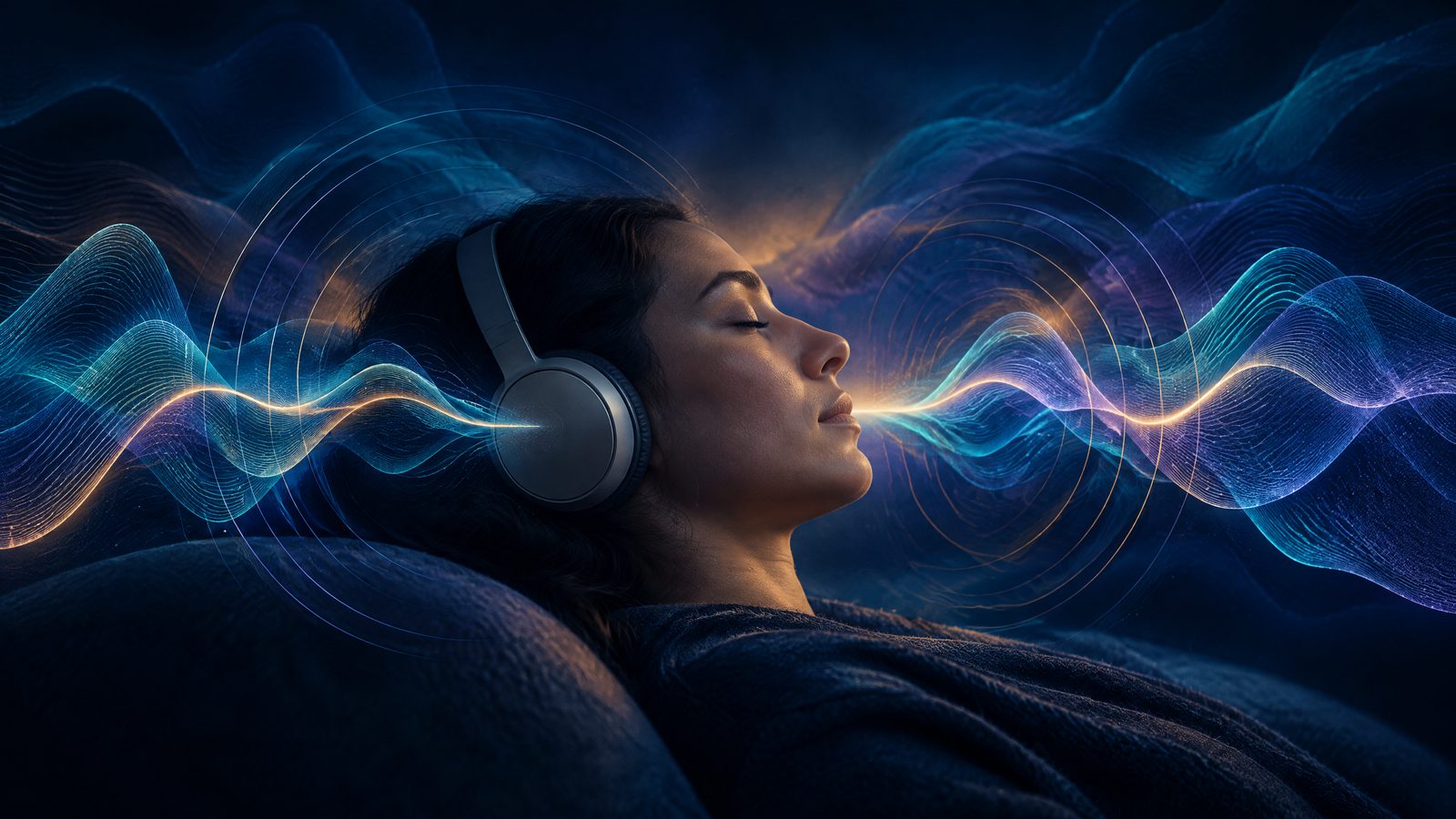
Can a 4 Hz binaural architecture deepen meditation?
UltraMind OBE Threshold is a 45-minute, nine-phase meditation composition designed for quiet, stationary practice, inward attention, hypnagogic exploration, and subjective changes in imagery or felt perspective. Its core design feature is a 4 Hz interaural difference intended for conventional stereo-headphone listening. The important question is not whether one number can compel a result. It is whether a carefully sequenced 4 Hz binaural architecture can give meditation a clearer container for settling, sustained attention, imagery, and deliberate return.
The evidence supports a measured answer. Binaural beats are a real auditory percept that may arise when nearby tones are presented separately to the ears. Research on EEG and wellness effects is active, but outcomes are protocol-dependent and mixed. A 4 Hz binaural composition can be an intentional meditation design, yet it is not evidence that every listener enters a 4 Hz brain state, nor a universal trigger for an out-of-body experience.[1] [2]

The 4 Hz binaural idea, accurately stated
A binaural beat is not a literal low-frequency tone placed into one ear. It is a possible perceptual rhythm associated with the frequency difference between two nearby tones when channel separation is preserved. That distinction matters. A binaural percept, an auditory-pathway response, a measured EEG change, a calming subjective report, and an OBE are different outcomes that require different evidence.[1]
UltraMind uses 4 Hz as a phase-specific sound-design relationship inside a longer composition. The architecture is designed to encourage an unhurried shift from external orientation toward quieter inward attention. It does not claim to force the brain into a named state. A 2023 systematic review of eligible EEG studies found mixed evidence, with five supportive, eight contradictory, and one mixed result, which is why responsible use of 4 Hz language belongs in the realm of disciplined meditation design rather than neurological certainty.[2]
Why the nine phases matter
UltraMind is not built around a static tone held indefinitely. Its nine named phases create a meditation arc: Neural Release, Sensory Withdrawal, Theta Immersion, Hypnagogic Descent, Threshold Approach, UltraMind Deep State, OBE Threshold Hold, Reintegration, and Conscious Return. The sequence gives the session a beginning, a deep-practice center, and an explicit exit. This is a compositional decision that supports pacing and a more intentional relationship to listening. It is not a claim to eliminate adaptation or a claim of clinical superiority over every static signal.

That structure also makes the phrase deep trance more useful. Here it describes a subjective practice of absorption, relaxation, imagery, and reduced attention to surroundings. It is not a diagnostic label, a verified EEG depth, or a promise that every session becomes dramatic. Some listeners may remain fully awake. Others may notice sleep-adjacent imagery or a change in time sense. The design creates room for observation without requiring a particular story about what must happen.
OBE exploration, hypnagogia, and personal experience
Out-of-body experiences can be discussed with precision and respect. In research settings, OBE-like episodes are described as subjective changes in self-location or perspective and are associated with multisensory and vestibular self-processing. That literature does not establish that an audio track produces physical separation of consciousness, remote viewing, or paranormal perception.[3]
At the border of sleep, hypnagogic experience can include vivid imagery, unusual body sensations, floating or falling feelings, altered spatial sense, and a sensed presence. These experiences can be personally meaningful while still being sleep-transition perceptions. UltraMind uses OBE Threshold as an invitation to contemplative and imaginative exploration, not a guarantee of an OBE or a claim about external reality.[4]

The research context for meditation use
Small, protocol-specific studies have reported changes in theta or alpha measures under particular binaural conditions, and systematic reviews and meta-analyses report research interest in calmness, attention, memory, anxiety, and pain outcomes. Those results cannot be transferred directly to a specific commercial 4 Hz composition. They do, however, support ongoing inquiry into how carefully designed audio may accompany focused rest and meditation.[5] [6]
The strongest reader-facing conclusion is straightforward: a well-made 4 Hz binaural session may be a meaningful tool for people who enjoy quiet, structured meditation and inward attention. Its value is experiential and practice-based. The research does not validate claims that it guarantees brainwave entrainment, OBE, astral projection, remote viewing, treatment of anxiety, or treatment of a neurological or psychiatric condition.
Seven-day UltraMind practice routine
Run the primary program first every day. After it ends, leave a 10-minute quiet gap before beginning any linked companion. The two companions shown each day are optional and may be used as a quiet continuation only when they feel comfortable and welcome. Do not stack programs to pursue intensity. After Day 7, take a one-week pause before any optional repeat.
Best practices for a quieter session
Prepare the setting before pressing play. Dim the room, silence notifications, use a comfortable seated or reclined position, and keep a journal nearby if reflection is useful. Begin with a low, comfortable volume and let the program’s return phase finish before standing. More volume, more devices, or more back-to-back sessions do not make a binaural relationship more accurate or make an experience more meaningful.
If using a Metatronic Flower of Life Dual Frequency Imprinter as an optional personal ritual layer, keep it separate from the headphone path and use it according to its manufacturer guidance. It is not necessary for the audio practice, and it does not make medical, neurological, or paranormal outcomes more likely. The simplest approach remains the most informative: one quiet primary session, a 10-minute pause, and a clear return to ordinary surroundings.
Headphones first, optional devices second
For the primary binaural presentation, conventional stereo headphones are the appropriate starting point because they are designed to preserve separate left and right routing. Use a low, comfortable listening level. The World Health Organization emphasizes that sound level and listening duration both contribute to exposure.[7]
Haptic systems, bone-conduction devices, and optional consumer coil systems are separate playback paths. Bone conduction has substantial interaural cross-talk, while haptic and coil output depend on the specific device, mounting, amplifier, and measurement. The audio file does not establish vibration amplitude, field strength, device compatibility, or a biological effect.[8] Follow all manufacturer guidance and contraindications for connected hardware.

Wellness resources and affiliate links
| Resource | Role in this feature |
|---|---|
| Frequency Healing App | Platform resource for the linked UltraMind composition and companion programs. |
| iTorus i2 | Optional consumer-wellness device. Follow manufacturer instructions and contraindications. |
| iTorus i5 | Optional consumer-wellness device. Follow manufacturer instructions and contraindications. |
| Woojer Vest 4 | Optional vibrotactile layer. Use code EPEMF10 where accepted. |
| Metatronic Flower of Life Dual Frequency Imprinter | Optional ritual or wellness layer. This is not a medical or paranormal claim. |
Safety and scope
Use only while stationary. Do not use while driving, cycling in traffic, operating machinery, swimming, bathing, or during another activity that requires continuous alertness. Do not begin a session before planned driving. If you feel sleepy afterward, do not drive until fully alert. Stop and reorient to the room if you experience panic, marked dizziness, confusion, disturbing perceptual changes, or detachment that feels unsafe or impairs functioning.
Seek individualized professional guidance before using an intensive inward-focused session if you have epilepsy or a seizure history, unexplained seizure-like events, a known sound trigger, severe daytime sleepiness, implanted electronic or magnet-sensitive medical devices, or current or recently worsening hallucinations while awake, delusional beliefs, severe mood elevation, major confusion, or impaired reality testing. Seek professional help for recurrent or distressing sleep-transition experiences, hallucinations when fully awake, rapidly worsening confusion, or symptoms that impair daily life. This program is educational wellness content, not medical or mental-health treatment.[4] [9]
Related Articles
- Digital Frequencies vs. Rife Machines
- EMF & Schumann Harmonic Coherence Matrix
- Burnout & Mental Exhaustion: 9-Phase Cognitive Recovery
References
- Pratt et al. Cortical evoked potentials to an auditory illusion: binaural beats. Clinical Neurophysiology. 2009.
- Ingendoh, Posny, and Heine. Binaural beats to entrain the brain? A systematic review of effects on brain oscillatory activity. PLOS ONE. 2023.
- Blanke. Out of body experiences and their neural basis. BMJ. 2004.
- American Academy of Sleep Medicine. Sleep hallucinations.
- Jirakittayakorn and Wongsawat. Brain responses to a 6-Hz binaural beat: effects on general theta rhythm and frontal midline theta activity. Frontiers in Neuroscience. 2017.
- Basu and Banerjee. Potential of binaural beats intervention for improving memory and attention: insights from meta-analysis and systematic review. Psychological Research. 2023.
- World Health Organization. Deafness and hearing loss: safe listening.
- Wang et al. Analysis of cross-talk cancellation of bilateral bone conduction stimulation. Hearing Research. 2023.
- National Center for Complementary and Integrative Health. Meditation and mindfulness: effectiveness and safety.
Explore PEMFHealing.app
Your companion for structured frequency programs and progress tracking.
Why full spectrum frequencies can feel stronger than a single tone
- Broader coverage across biological windows, not a narrow peak.
- Harmonics and sidebands can support entrainment and coherence.
- People vary by tissue state and time of day, so spectrum raises the chance of a match.
- Lower adaptation risk compared to repeating a single tone for long periods.
Dual channel vs single channel
- Two independent channels can run complementary programs at once.
- Phase and field options may create a smoother perceived field.
- Target local and systemic aims together, for example focus plus relaxation.
Why we use multi modality, not only Rife
Complex systems benefit from more than one input. We layer modalities to address different pathways and timescales.
- WBV for circulation and lymph support
- VibroAcoustics for relaxation and coherence
- Pro Rife and Ultra Rife targeted frequency sets
- ElectroHerbalism mild field patterns with botanicals
- NeuroCeptors gentle neuromodulation for calm and focus
- Biophotonics light based cellular signaling support
- Scalar field coupling for subtle energy work
- Plus PEMF, photobiomodulation, breathwork, HRV awareness, and more
Our ecosystem
-
Imprinter imprint supportive signatures into water, supplements, crystals, or pendants.
Metatronic Flower of Life Dual Frequency Imprinter -
iTorus i2 portable PEMF coil for on the go sessions.
iTorus i2 -
iTorus i5 higher output portable PEMF.
iTorus i5
Disclosure: Some links may be affiliate. If you purchase, we may receive a small commission at no extra cost to you.
Disclaimer: This content is for informational purposes only and is not medical advice. Always consult a qualified healthcare professional before starting any new therapy or using frequency based devices.
Related articles
- Glaucoma & Optic Nerve: 12-Phase Ocular Research Guide
- The 20-Minute iTorus Muscle Test: 7 Days, Active vs Sham
- Malachite Heart Stone: A 12-Part Heart Circle Guide
- Vogel Crystal Light: The 7-Color BioPhi Collection Explained
- 432 Hz vs 440 vs 444: The Math Verdict on 13 Tunings
- Calminity vs PEMF Healing: Static Frequency vs BioPhi Programs