
Digital Frequencies vs. Rife Machines: Signal Physics, Output Chains, and What Actually Matters
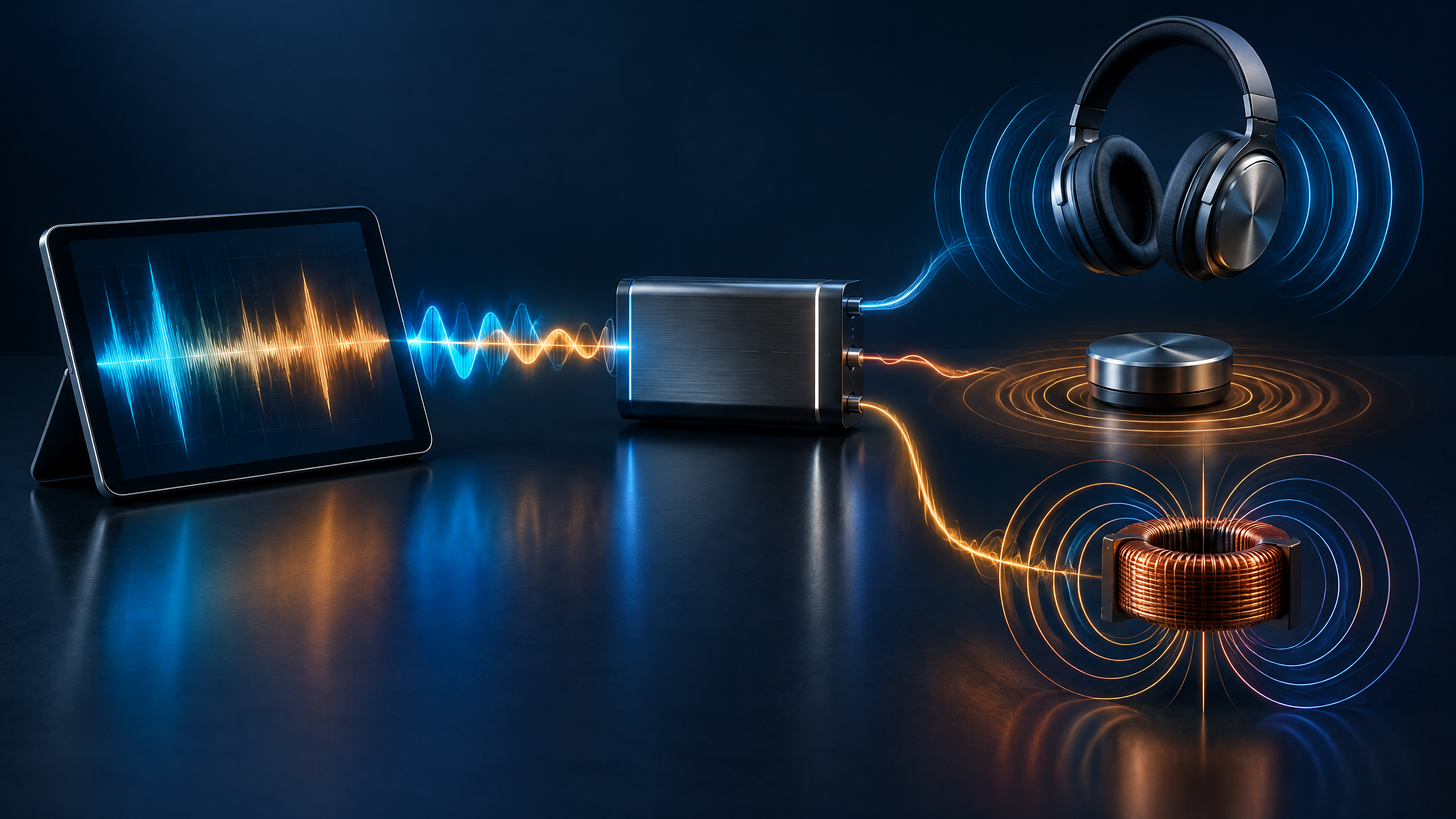
Are Rife frequencies more real than digitally generated frequencies? The answer is not found in the age of a device, the authority of a frequency chart, or the weight of a metal enclosure. It is found by following the signal all the way through its architecture. A waveform from software becomes a measurable electrical output after digital-to-analog conversion. What it becomes next depends on its output chain and transducer: acoustic pressure at headphones, mechanical vibration at a haptic surface, or a time-varying electromagnetic field at a compatible coil.
That answer leads to a larger and more consequential conclusion. The era worth leaving behind is not the use of frequency itself. It is the one-number era, the assumption that a fixed numerical label is the entire design, the entire mechanism, and the entire argument. A single repeated tone can be technically valid as a waveform. It can be useful as a reference, a calibration point, or a deliberately simple cue. Yet it is an exceptionally narrow signal architecture. It holds most of the variables that shape temporal experience fixed, then asks one number to carry the entire conceptual load.
BioPhi bioelectrical harmonic and phase-based design begins from a different premise: a session is not a number. It is an organized event in time. Frequency anchors can be placed within a living arrangement of harmonic relationships, phase relationships, modulation contours, pulse timing, stereo routing, transition envelopes, texture, and planned sections. The point is not to make a mystical claim about complexity. The point is to make the design legible. A composed program gives a user a temporal environment with an entry, development, integration, and exit. It does not ask an invariant cue to do all the work.
The decisive distinction: a Rife-style box does not make a signal more real merely because it is a box. A static frequency does not become a complete architecture merely because it has a name. The mature question is what the system actually delivers, how that delivery changes across time, and what direct evidence exists for the exact context.
The End of the One-Number Era
For decades, frequency culture has often been organized around a seductive idea: identify the right number, deliver it long enough, and the number itself carries the result. This framework has intuitive appeal because it is simple. It also makes comparison easy. A user can ask whether one device offers 100, 1,000, or 10,000 selectable values, then mistake the size of the list for the depth of the design.
But a list of values is not yet a signal architecture. It says little about waveform shape, spectral distribution, amplitude, phase, timing, duty cycle, modulation, output loading, transducer geometry, session progression, or measurement location. It says even less about whether the listed value is delivered through sound, vibration, or a time-varying field. Those are not technical footnotes. They are the actual conditions that determine what exists at the output.
This is why the term Rife era is best used as a design critique, not a dismissal of hardware or of engineering. It names a frequency-first model in which the selected value is treated as the principal differentiator. The next design era is more demanding. It asks the system to explain its complete signal grammar. A platform must be able to say what changes, when it changes, how it is routed, how it is rendered by each transducer, and what can genuinely be inferred from the output.
The transition from static selection to phase-based composition is therefore not an argument against frequency. It is an argument for putting frequency back into its proper place. Frequency is one coordinate in a wider design space. It can be an anchor, a reference, an interval, a carrier, a beat relationship, or a component of a harmonic structure. It is not a self-sufficient explanation of a whole session.
Follow the Signal: Where “Digital” Becomes Physical
A digital signal begins as a sequence of samples. A digital-to-analog converter, or DAC, reconstructs those values as an analog electrical output. Downstream filtering, amplification, impedance, cable behavior, and the connected load influence what reaches the final transducer. In an audio path, a driver moves a diaphragm and creates acoustic pressure. In a haptic path, an actuator creates mechanical vibration. In a compatible coil system, an electrical drive produces a time-varying electromagnetic field.[1]
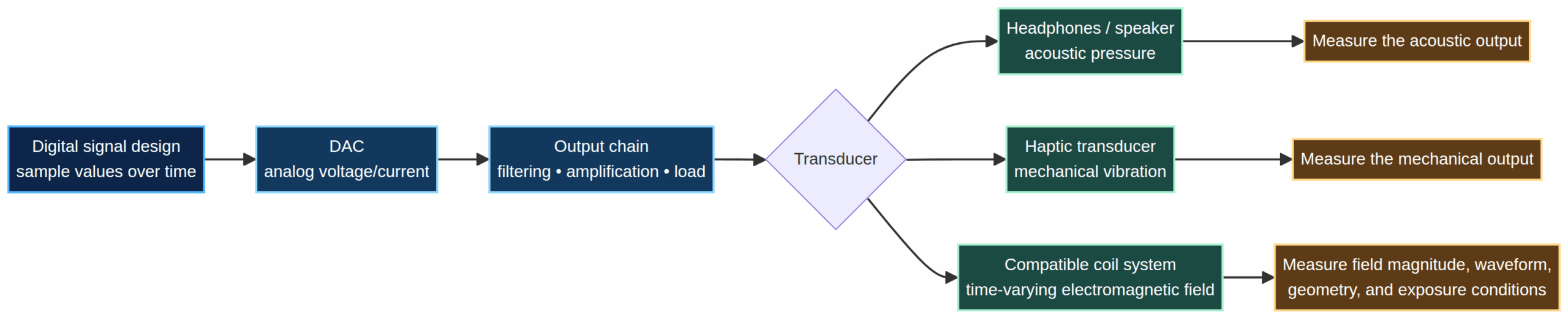
Digital does not mean imaginary. It means the signal was specified, stored, or computed in digital form before conversion. Analog does not mean inherently more biologically meaningful. It describes a continuous electrical representation. The relevant quality question is not digital versus analog in the abstract. It is whether the system has a coherent design, an appropriate output stage, a known transducer, and an output that can be characterized.
This is also why a phone speaker is not a PEMF coil, and why a coil is not a headphone. A layered program may coordinate audio, haptic, and compatible-coil pathways, but coordination is not equivalence. Each pathway has its own physics. Each should be described by its own output variables. A serious architecture respects the distinction rather than hiding it under a single word such as “frequency.”
Why Apple and Android Change the Composition Problem
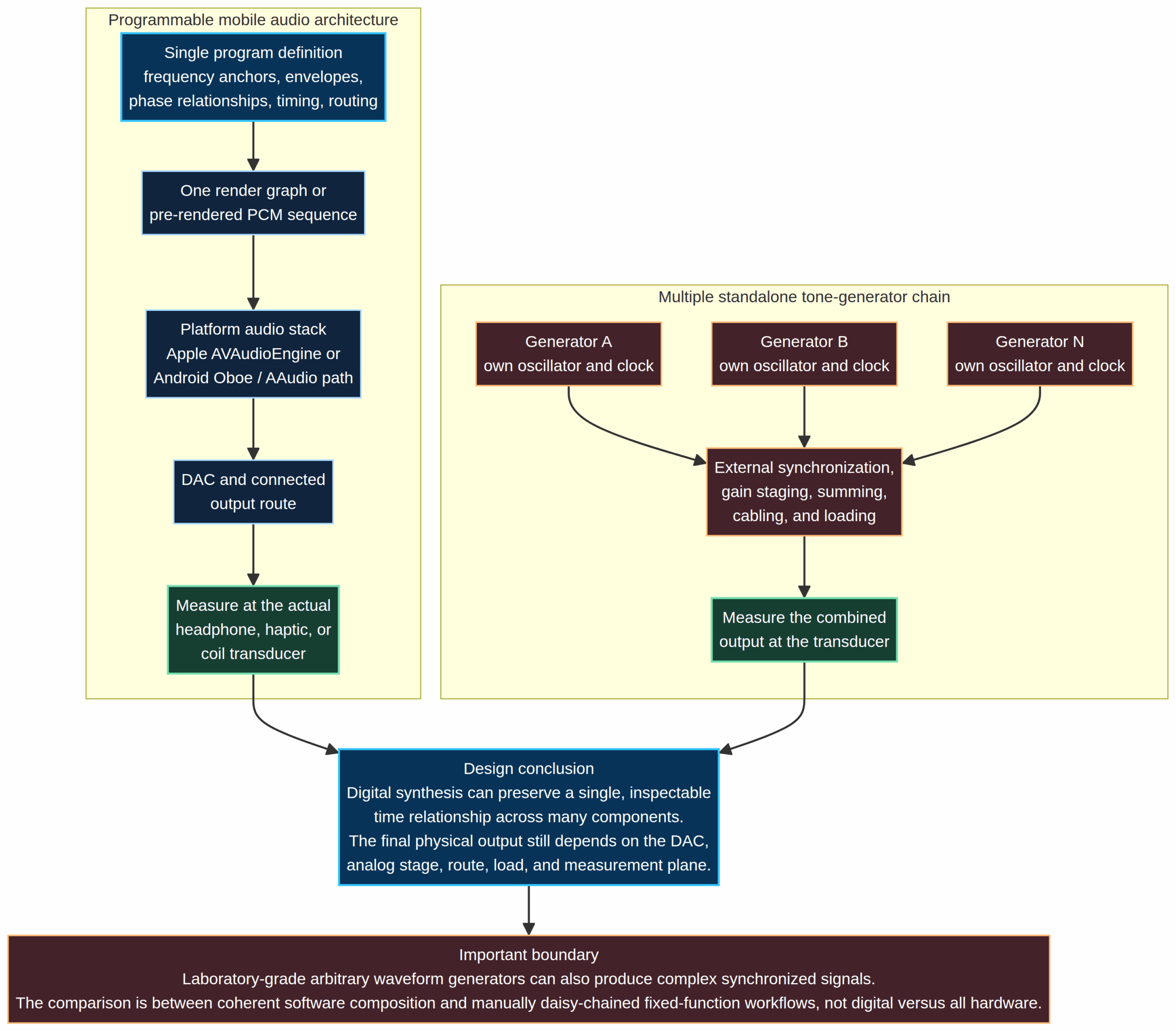
A modern mobile platform is not merely a catalogue of preset tones. Apple’s AVAudioEngine is a graph-based framework that can attach, connect, mix, and render audio nodes in real time or in manual rendering mode. Apple also documents source nodes that accept a developer-supplied render block, allowing a program to generate audio samples as part of a managed render path.[11] [12] On Android, the Oboe and AAudio paths expose stream configuration, output callbacks, buffer management, channel formats, and low-latency requests. Google’s Oboe documentation includes a callback-based digital-synthesis example that calculates output samples directly.[13]
That architecture changes the composition problem. Instead of asking a user to place independent boxes beside one another and hope their outputs stay in relationship, a single software definition can specify multiple components on one sample timeline. Frequency anchors, amplitude envelopes, phase offsets, modulation contours, stereo routing, entry points, exits, and section transitions can be composed together before the final output is rendered. A pre-rendered PCM sequence can preserve the same coherent relationship throughout playback, while a real-time render graph can calculate the next audio frames from the same program definition.
This is the meaningful form of precision in a BioPhi workflow: coherence of the programmed relationship. It is not a vague claim that every phone produces a universally perfect physical waveform. The final acoustic, haptic, or field output still depends on the device clock, DAC, analog stage, connected route, amplifier or driver, load, and the measurement plane. A serious platform therefore treats output measurement as the final arbiter, not the mobile brand on the enclosure.
The same distinction corrects a common misuse of the phrase slew rate. A composer can specify abrupt or gradual sample-to-sample changes, amplitude envelopes, pulse edges, and modulation curves in the digital program. The physical slew rate of an analog output stage is a different property. It belongs to the DAC, amplifier, or driver and must be characterized at the output. Software can define a transition trajectory. It cannot promise a chosen hardware slew rate without a measured output specification.
As the number of coordinated components grows, manually chaining independent fixed-function tone generators creates a different engineering burden. Each device may bring its own oscillator, clock, level control, output impedance, cable path, and synchronization requirement. To preserve a controlled relationship across many boxes, the system needs common timing, stable summing, gain staging, loading management, and verification at the final transducer. This is why a single program-defined render path is a more practical architecture for complex composition than manually daisy-chaining many standalone oscillators.
There is an important boundary. A laboratory-grade arbitrary waveform generator can also synthesize complex waveforms, modulation, and synchronized outputs. The distinction is not that all hardware is primitive or that all digital systems are automatically superior. The useful comparison is between coherent software composition on a shared timeline and a manually chained fixed-function consumer-generator workflow. BioPhi is designed around the former because it makes a long, multicomponent phase architecture inspectable, repeatable, and feasible without turning the session into a tangle of independent devices.
Why Static Frequency Design Becomes Structurally Limited
A constant tone is not inherently defective. In engineering, stationary signals can be useful. They are easy to generate, inspect, measure, compare, and use as a stable reference. A sustained sine wave is particularly clean because it concentrates its energy at a single frequency in the idealized case. That simplicity is valuable when the question is calibration or basic waveform verification.
Its limitation appears when a constant tone is promoted from a reference signal to a total program philosophy. An invariant signal holds its temporal context largely fixed. Its waveform does not develop through planned transitions. Its harmonic relationships do not evolve. Its phase relationships do not form a sequence. Its modulation contour is absent unless added. Its output may remain measurable, but its architecture remains narrow.
Calling that output “static noise” would be technically inaccurate. A pure tone is not noise in the signal-processing sense. Noise is typically irregular or broadband and lacks the ordered periodicity of an ideal tone. The more accurate statement is this: a single invariant cue can become perceptually familiar, less informative, or monotonous for a user over time, depending on the modality, intensity, duration, context, and person. The engineering response is not to invent a medical explanation. It is to acknowledge that a session can be designed with more temporal intelligence than an endless loop.
| Design question | One-number, stationary model | BioPhi phase-based model |
|---|---|---|
| Primary unit of design | A selected fixed value | A sequenced relationship among multiple design variables |
| Time structure | Mostly invariant unless manually changed | Deliberate sections, transitions, envelopes, and reintegration |
| Frequency role | Treated as the central or sole explanatory variable | Used as one anchor within harmonic, phase, and timing relationships |
| Signal context | Limited change in the cue itself | Planned evolution in spectral, phase, modulation, and routing context |
| User experience question | “Which number should I run?” | “What is this session organizing across time?” |
| Evidence question | Often detached from output details and exact use | Requires the same discipline: measure output, identify modality, then assess direct evidence |
The table does not declare every dynamic design superior in every setting. It clarifies a design difference. Stationarity is a narrow but legitimate tool. A phase-based composition is a wider engineering language. It can make deliberate use of change, relationship, and sequence.
Temporal Context Is Not a Detail
The strongest scientific reason to take time structure seriously is not a slogan about “defeating adaptation.” It is the much more interesting observation that sensory processing is sensitive to temporal context. In a major review, Solomon and Kohn describe sensory adaptation as a set of mechanisms through which responses become sensitive to the temporal context in which stimuli occur. The review emphasizes that adaptation is not reducible to a simple fatigue story. Its effects can be suppressive, facilitatory, stimulus-specific, duration-dependent, and distributed across multiple processing stages.[9]
That matters because repetition is not a single phenomenon. A response can change with the duration of exposure, with how closely a later stimulus resembles an earlier one, with the timing between events, and with the broader context in which the sequence is embedded. In a human visual MEG study, repeated versus novel stimuli were associated with changes in response strength and peak latency, illustrating that repetition-related effects have temporal dimensions as well as amplitude dimensions.[10]
A phase-based program does not claim to control those mechanisms. It does something more modest and more defensible: it refuses to build the entire session around an assumption that temporal context is irrelevant. It can use transitions rather than abrupt repetition. It can alter relationships among components rather than leaving every parameter fixed. It can introduce an entry phase, a developmental phase, an integration phase, and an exit phase. That is what makes it an architecture rather than a playlist of numbers.
The practical distinction is not “static bad, dynamic magical.” It is “stationary is one design option, while temporal composition gives the designer far more degrees of freedom.” Those degrees of freedom are the basis of a richer, more intentional, and more inspectable program.
Adaptation, Habituation, and the Cellular-Adaptation Claim
Terms such as adaptation, habituation, desensitization, fatigue, and cellular adaptation are often used as if they all describe the same process. They do not. Habituation is generally used for a progressive reduction in response to repeated stimulation in a specific context. Sensory adaptation refers to changes in sensitivity related to recent sensory history. Cellular responses to a physical stimulus are a separate experimental question, requiring an exact field or signal description, a particular cell model or tissue context, and a measured endpoint.
Research supports the general proposition that repeated stimuli can change responses in studied systems. It does not support the blanket statement that all static consumer frequencies create a universal “cellular adaptation problem,” nor does it establish that every phase-based wellness program solves such a problem. Pulsed electromagnetic field research itself is highly parameter-dependent. A systematic review of in-vitro studies evaluated frequency, flux density, waveform, exposure time, and cell type, reporting heterogeneous results across experimental contexts.[2]
The conclusion for responsible design is powerful without being inflated. BioPhi programs are built to avoid collapsing the session into a single invariant cue. Their phase-based structure can change the temporal relationships among signal components by design. This is a key differentiator because it transforms the program from a static selection into an evolving composition. It is not a promise that a program can eliminate adaptation at the cellular level. It is a refusal to treat adaptation, context, and time as though they do not matter.
That distinction also protects the reader from a false binary. The goal is not to “outsmart” biology with novelty. Human sensory systems are adaptive by nature. The goal is to design with that fact in view. A living architecture gives time a role in the program. It treats change as an organized variable rather than an accidental departure from a fixed tone.
What Makes a BioPhi Program a Living Architecture
The term living architecture is used here as a design description, not as a claim that a file is alive or that it creates a biological organism-like response. It means the program has internal development. Its elements are arranged through time so that the relationship among them changes in a coherent way.
A phase-based BioPhi composition can publicly be described through six design layers:
- Frequency anchors. Reference components provide identifiable points of organization without pretending that one number is a complete program.
- Harmonic architecture. Related components are arranged so that the spectrum has structure rather than a single isolated line.
- Phase relationships. Relative timing among components can be organized across sections, producing transitions that are part of the composition rather than accidental by-products.
- Modulation and envelopes. Amplitude, pulse timing, or other parameters can be shaped through gradual contours instead of being held invariant for an entire session.
- Multimodal routing. Audio, haptic, and compatible-coil layers can be coordinated while remaining physically distinct at their outputs.
- Session dramaturgy. The program can establish an entry, build a central development, create integration, and provide an exit. This gives the listener or user a complete temporal form.
None of these layers requires disclosure of proprietary numeric mappings, internal reference values, or translation math. The differentiator is not a secret number. It is the decision to treat relationships and progression as first-class design variables.
This is why the phrase “just a tone” is inadequate for a well-composed program. A tone is an element. A program is the relationship among elements across time. In music, the difference between a note and a composition is not cosmetic. A note can be measured in isolation; a composition has sequence, expectation, contrast, tension, release, and form. BioPhi applies that organizational insight to signal design while retaining the discipline that each physical output pathway must be measured on its own terms.
Why Harmonics and Phase Matter More Than a Marketing List
A static-frequency catalog invites a shopping mentality. It encourages readers to ask which label is strongest, rarest, or most exclusive. Harmonic and phase-based design changes the question. It asks how components work as a relationship.
In engineering terms, a waveform is not only defined by what frequencies are present. It is also shaped by their amplitudes and relative phases. Change the phase relationship among components and the time-domain waveform can change even if the component frequencies remain the same. Apply an envelope or modulation contour and the signal develops over time. Introduce transition rules and the session gains form. These are not metaphors. They are ordinary design variables in signal processing and audio engineering.
That does not mean any harmonic stack automatically produces a biological outcome. It means harmonic organization is a real way to construct a more complex and time-aware signal than a single continuous oscillator. The reason this matters is architectural clarity. A phase-based program can explain why it has sections, why transitions are gradual, why components enter or recede, and why the overall session is not equivalent to a fixed tone held for the same duration.
The same discipline applies to visual representations. A spectrum describes frequency components. A spectrogram is a time-frequency visualization of audio or another measured signal. Neither is spectroscopy, an ocular measurement, a biological scan, a dose display, or proof of a health effect. The visual can show organization in the produced signal. It cannot, by itself, show an outcome in a person.
Audio, Haptics, and Compatible Coil Support: One Design, Different Physics
A mature program platform can coordinate several delivery layers without pretending they are identical. Headphone audio provides a stereo acoustic pathway. Haptic hardware provides tactile mechanical vibration. A compatible coil system provides a time-varying electromagnetic output. The value of layered design is that it can organize an experience across these pathways. The responsibility of layered design is to state that each pathway has different physical characteristics and different evidence requirements.
Binaural audio is a useful example. When separate tones are presented to the ears, a listener may perceive a binaural-beat phenomenon at the difference frequency. That makes binaural design a legitimate psychoacoustic compositional tool. The evidence for consistent brainwave entrainment, however, remains mixed. A 2023 systematic review found heterogeneous methods and inconsistent outcomes across fourteen included studies.[6] The proper conclusion is not that binaural design is unreal. It is that it should be described as a headphone-based audio layer rather than as reliable control over a brain state.
The same precision strengthens, rather than weakens, the BioPhi proposition. The program does not need to claim that all modalities are the same. It can state exactly what it is designed to do: coordinate multiple pathways in a sequenced composition while preserving the distinct physics of each output.
The Evidence Ladder: From Waveform to Claim
A recurring problem in frequency discourse is that four very different questions are treated as one. First, does a specified waveform exist at the output? Second, is the output properly characterized? Third, is there relevant research on a similar modality or parameter set? Fourth, is there direct evidence for the exact device, protocol, population, and outcome? A positive answer at one level does not automatically answer the next.
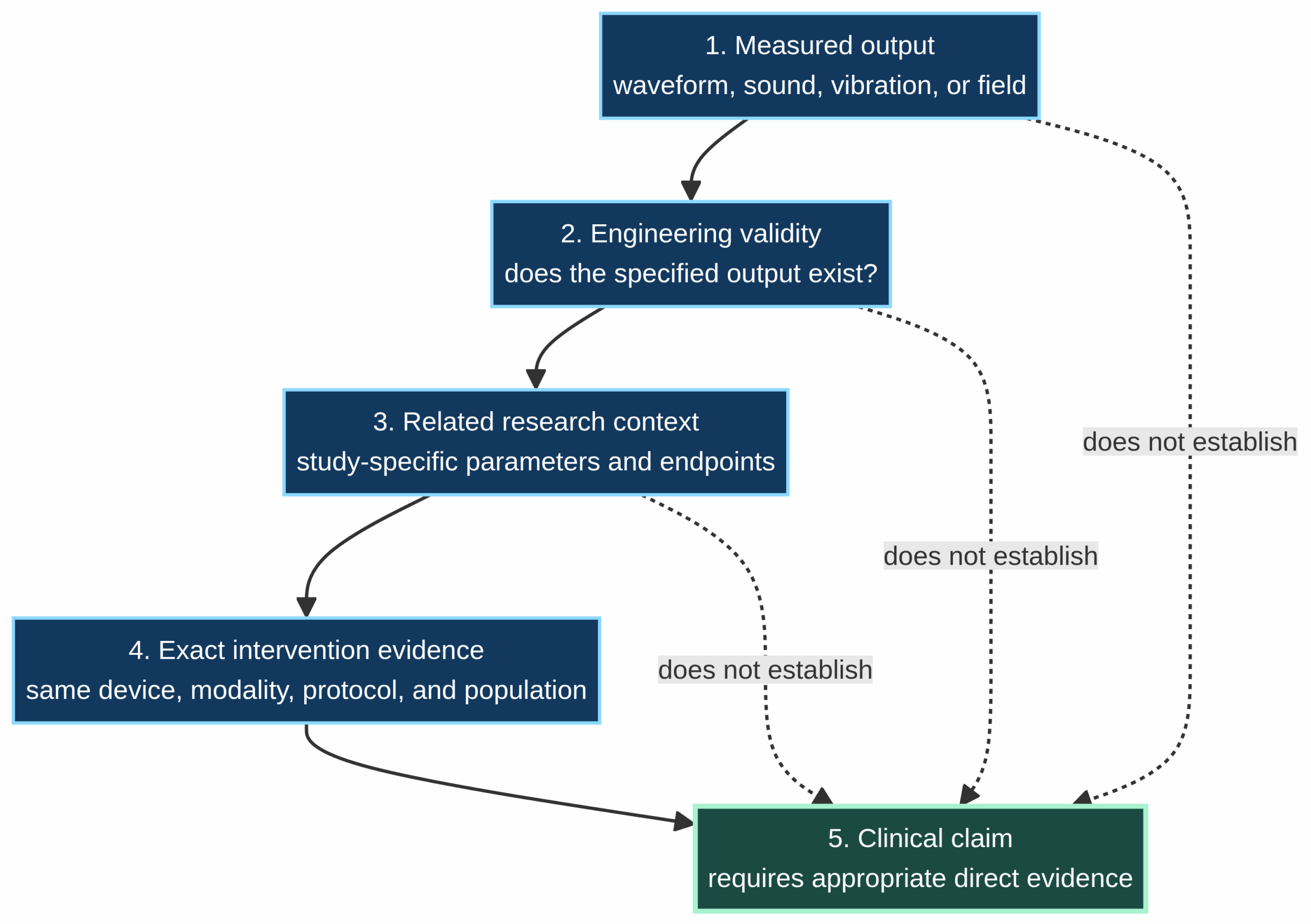
This hierarchy is what separates a serious signal-architecture discussion from a mythology of frequency labels. It allows a platform to be ambitious in design and disciplined in inference at the same time. A program can have a sophisticated internal architecture. A waveform can be real and measurable. A signal can be dynamic and richly composed. None of those facts alone authorizes diagnosis, treatment, cure, prevention, or a guaranteed outcome.
What the Rife Name Can and Cannot Establish
The Rife name remains historically influential because it represents the promise that a condition can be addressed by finding the right corresponding frequency. It also persists because a box with dials, cables, and frequency controls can look more authoritative than a contemporary digital platform. But visual authority is not output characterization, and output characterization is not clinical proof.
Reputable cancer-information sources state that there is no reliable evidence for using Rife machines as a cure for cancer. Regulators also caution against unproven disease-treatment marketing.[7] [8] Those boundaries should be kept firm. At the same time, the critique should remain technically accurate. A Rife-style device may generate a physical output. What must be assessed is the actual waveform, the output path, the delivery geometry, the measurement conditions, and the evidence for the stated purpose.
That is why the question “Are Rife frequencies more real?” has a clear answer. They are not more real because of the label. A number does not acquire biological authority from a legacy name. A contemporary digital system does not become lesser because its design began in software. The decisive standard is architecture plus measurement plus evidence.
A Seven-Day Signal-Architecture Exploration
This is a wellness-oriented, screen-free exploration of program formats, not a medical protocol. Each day starts with the same primary program to create a consistent opening reference. Two exact linked companions then introduce different compositional contexts. Use the visible in-app runtime, keep a 10-minute quiet interval between sessions, and stop if the experience is uncomfortable. Program titles are preserved as catalog names. They are not claims of diagnosis, treatment, cure, prevention, or guaranteed effect.
Optional repeat: After Day 7, take one full week away from the sequence. If you choose to repeat it, treat the second week as a fresh observation period. Do not escalate intensity, duration, or expectation simply because a program is phase-based.
Best Practices for Audio, Haptics, and Compatible Coil Systems
Audio: Keep volume comfortable and below 60% of device maximum. Use well-fitted headphones when stereo separation is desired, and take regular quiet breaks. The World Health Organization notes that listening risk rises with sound level and duration.[5] Persistent ringing, pain, or hearing difficulty warrants stopping and seeking advice from a qualified hearing professional.
Haptics: Follow the device manufacturer’s instructions, begin conservatively, and use tactile output as an accompaniment rather than a reason to increase volume or chase intensity.
Compatible coil systems: Follow the manufacturer’s connection, contraindication, and positioning guidance. Do not place a coil over the eyes, head, or an implanted electronic medical device. People with implanted electronic devices, pregnancy, seizure history, or a condition requiring medical supervision should consult an appropriately qualified clinician before using a pulsed-field device.
Optional Platform and Hardware Resources
| Layer | Resource | Practical role and boundary |
|---|---|---|
| Platform access | Frequency Healing App | Access the platform workflow and program library. Audio-program design is not a medical treatment claim. |
| Compatible PEMF | iTorus i2 or iTorus i5 | Consumer-wellness hardware options. Follow manufacturer instructions, output guidance, placement guidance, and contraindications. |
| Haptic | Woojer Vest 4, use code EPEMF10 | Optional vibrotactile layer for a program experience. It is not a medical intervention or an evidence substitute. |
| Imprinting | Metatronic Flower of Life Dual Frequency Imprinter | Optional ritual or wellness hardware. No health outcome is implied for imprinted water or related use. |
The Conclusion: From Frequency Selection to Signal Composition
The question is no longer whether software can produce a real signal. It can. The question is whether we are willing to move beyond a design culture that treats frequency selection as the end of the inquiry.
A static tone can be a valid reference. A Rife-style device can produce a physical output. Neither fact makes a single invariant number a complete program, a biological explanation, or a clinical result. The next step is signal architecture: a design that uses frequency anchors inside a phase-based, harmonic, time-aware composition; maintains the distinction among audio, haptic, and field pathways; and keeps measurement and evidence at the center of the claim.
That is the BioPhi differentiator. It is not a promise to eliminate adaptation. It is a more ambitious design response to the reality that time, context, relationship, and transition matter. It replaces the question “Which number should I run?” with a more valuable question: What kind of signal environment is this program deliberately organizing?
Affiliate Disclosure
Some links in this article are affiliate links. If you choose to purchase through them, PEMF Magazine may receive a commission at no additional cost to you. This support does not change the article’s evidence standards or wellness-only framing.
Safety and Scope
This educational article discusses signal concepts, consumer audio, haptics, and compatible field-device considerations. It is not medical advice and does not diagnose, treat, cure, mitigate, or prevent any condition. No waveform, spectrum, spectrogram, app, haptic layer, or coil output should be interpreted as a substitute for professional medical assessment or evidence-based treatment. Do not delay medical care for a serious symptom or diagnosis.
Related Articles
- Why the PEMF Healing App Outperforms Traditional Tone Generators
- Frequency Based Wellness Programs
- Royal Raymond Rife Was Not a Doctor: The Man, the Microscope and the Controversial Frequency Healing Legacy
References
- Valvano, J. Digital to Analog Conversion and Sound. University of Texas at Austin.
- Mansourian M, Shanei A. Evaluation of Pulsed Electromagnetic Field Effects: A Systematic Review and Meta-Analysis on Highlights of Two Decades of Research In Vitro Studies. BioMed Research International. 2021.
- Adibi M, Zoccolan D, Clifford CWG. Editorial: Sensory Adaptation. Frontiers in Systems Neuroscience. 2021.
- Grissom N, Bhatnagar S. Habituation to repeated stress: get used to it. Neurobiology of Learning and Memory. 2008.
- World Health Organization. Deafness and hearing loss: Safe listening. 2026.
- Ingendoh RM, Posny ES, Heine A. Binaural beats to entrain the brain? A systematic review of effects on brain oscillatory activity. PLoS One. 2023.
- Cancer Research UK. Rife machines.
- U.S. Food and Drug Administration. Questions and Answers: FDA alerts companies to stop illegal sale of products claiming to treat cancer.
- Solomon SG, Kohn A. Moving Sensory Adaptation beyond Suppressive Effects in Single Neurons. Current Biology. 2014.
- Noguchi Y, Inui K, Kakigi R. Temporal Dynamics of Neural Adaptation Effect in the Human Visual Ventral Stream. Journal of Neuroscience. 2004.
- Apple Developer Documentation. AVAudioEngine: a graph of audio nodes for real-time processing and rendering.
- Apple Developer. What’s New in AVAudioEngine. WWDC 2019.
- Android Developers. Low latency audio with Oboe and AAudio.
Explore PEMFHealing.app
Your companion for structured frequency programs and progress tracking.
Why full spectrum frequencies can feel stronger than a single tone
- Broader coverage across biological windows, not a narrow peak.
- Harmonics and sidebands can support entrainment and coherence.
- People vary by tissue state and time of day, so spectrum raises the chance of a match.
- Lower adaptation risk compared to repeating a single tone for long periods.
Dual channel vs single channel
- Two independent channels can run complementary programs at once.
- Phase and field options may create a smoother perceived field.
- Target local and systemic aims together, for example focus plus relaxation.
Why we use multi modality, not only Rife
Complex systems benefit from more than one input. We layer modalities to address different pathways and timescales.
- WBV for circulation and lymph support
- VibroAcoustics for relaxation and coherence
- Pro Rife and Ultra Rife targeted frequency sets
- ElectroHerbalism mild field patterns with botanicals
- NeuroCeptors gentle neuromodulation for calm and focus
- Biophotonics light based cellular signaling support
- Scalar field coupling for subtle energy work
- Plus PEMF, photobiomodulation, breathwork, HRV awareness, and more
Our ecosystem
-
Imprinter imprint supportive signatures into water, supplements, crystals, or pendants.
Metatronic Flower of Life Dual Frequency Imprinter -
iTorus i2 portable PEMF coil for on the go sessions.
iTorus i2 -
iTorus i5 higher output portable PEMF.
iTorus i5
Disclosure: Some links may be affiliate. If you purchase, we may receive a small commission at no extra cost to you.
Disclaimer: This content is for informational purposes only and is not medical advice. Always consult a qualified healthcare professional before starting any new therapy or using frequency based devices.
Related articles
- Human Biological Clock: Circadian and Ultradian Rhythm Guide
- The Formula: Sound, Light & Frequency, Unpacked
- Peripheral Nerve Pain & Diabetic Neuropathy: Evidence and a 6-Phase Wellness Guide
- Parasite Frequencies: What 60 Hz and 75 Hz Studies Actually Found
- Can Frequencies Disrupt Nanoparticles? What Graphene, Silver, and Nanorobot Research Shows
- Glaucoma & Optic Nerve: 12-Phase Ocular Research Guide